
Handyman Business
AI for Handymen: Quoting Small Jobs in Minutes
Quoting a $220 repair costs about the same as quoting a $12,000 remodel. Here is how a one-person handyman business uses AI to price small work off a text message and still make money on it.
By the HandyBro team11 min read
The short answer
AI for handymen means using software that reads a customer's photos and description and returns a priced, itemized quote — labor, materials, and quantities — without a site visit and without an evening at the kitchen table. It matters most on small jobs, because the work of quoting a $220 repair is nearly the same as quoting a $12,000 remodel, and you do it for jobs you never win. Cutting that overhead from an hour to a few minutes is what makes small work profitable again.
The app built for this is Handy Bro. You describe the job by typing or voice, attach the photos the client texted you, answer a few clarifying questions, and get a task-by-task breakdown with materials priced from live Home Depot and Lowe's data and labor at your own rates. Every line is editable, and the finished quote goes out as a branded proposal the client can approve on their phone.
Why small jobs are the hardest work to quote profitably
The overhead of quoting does not shrink with the job. A homeowner wants a quote on replacing a few deck boards. You drive twenty minutes each way, spend fifteen minutes looking at it, and another half hour that night pricing boards, screws, stain, and your time. Call it an hour and a half. The job is worth $220. Then work out how often that hour and a half produces nothing at all, because the homeowner went with the guy who answered first, or decided to do it themselves, or stopped replying.
That is the arithmetic that quietly runs a one-person handyman business. On a remodel, an hour of estimating against a five-figure job is nothing. On a service call it is a serious fraction of the money. And small jobs are the ones you get asked about constantly, usually by text, usually with two blurry photos attached.
So handymen end up in one of two traps. The first is quoting off the top of your head — a number over the phone that sounds about right, based on the last one of these you did. It is fast, and it is right often enough to feel fine, but the misses come out of your pocket. The tub surround with rotted backer behind it. The faucet whose shutoff snaps in your hand. You said a number, so you eat it.
The second trap is worse: you stop quoting small work. You set a floor so high that half the calls go elsewhere, or you just take longer and longer to reply until the lead goes cold on its own. Those small jobs were how you filled the gaps between bigger ones, and they are how you met the clients who later called you about the bathroom.
What AI actually changes for a one-person shop
Ignore most of what gets written about AI and construction. For someone who works alone or with one helper, three things change, and they all attack the same problem: the unpaid hours around the work.
- 1
You can price without driving out
Photos plus a few answers from the homeowner are enough to build a defensible number for most repair work. The drive-out stops being the price of entry and becomes something you do for the jobs that genuinely need it — hidden damage, additions, anything structural.
- 2
You reply while the lead is still warm
Most handyman work goes to whoever comes back first with a real number, not to whoever is cheapest. A homeowner who texts three people on a Tuesday morning has usually hired someone by Tuesday night. Quoting in ten minutes on your phone puts you first almost by default.
- 3
Your paperwork stops looking like a text message
A one-person shop competes against companies with an office. An itemized proposal with your logo, a clear scope, and an approve button reads as a business, not as a guy with a truck. That changes what people are willing to pay before you have said a word about price.
None of that requires changing how you work. You still show up with the same tools and do the job the same way. What moves is the hour before and the hour after.
Quoting from a text message, start to finish
Here is a real shape of a lead. A homeowner texts at 8:40 in the morning: “Hi — back deck has a couple rotten boards and needs re-staining, can you take a look?” Attached are two photos, one of the whole deck from the back door and one closer shot of a soft board near the steps.
You are already on another job, so you do this from the truck at lunch. You forward the two photos into the app and paste her message in as the description. The AI reads the wide shot and picks up what you would: a ground-level deck, roughly rectangular, pressure-treated boards, weathered gray, an existing finish that has mostly given up. The close shot shows the cupping and the darker rot at the board end over a joist.
Then it asks. That is the part that matters, because these are the questions that actually move the price:
- How many boards are rotten, and how long is each one — a full-length run or short pieces near the rail?
- What size are the boards? Five-quarter by six is not the same buy as a two-by-six.
- Is the substructure sound, or does the deck feel soft when you walk on it?
- Stain or paint, and is anything already on there that has to come off first?
- Is the deck at ground level or elevated, and can a wheelbarrow reach it?
- Is there furniture, a grill, or a hot tub that has to move before work starts?
You know the answers to some of them from the photos. The rest you text back to her in one message, and she replies within the hour: six boards, five-quarter by six, sixteen feet, mostly near the steps; deck feels solid; she wants it stained, not painted; the grill and a table need to move.
What comes back is a task breakdown, not a single number. Demo and haul-away of the six boards. Replacement decking and stainless fasteners, with quantities, priced from current supplier data rather than from what lumber cost the last time you checked. Sanding and prep across the full deck surface, which is the line most people forget and the one that eats the afternoon. Stain, with coverage figured against the square footage. Cleanup and furniture reset.
You review it the way you would review a quote from a helper. The prep hours look light for a deck that gray, so you raise them. You delete a line for railing touch-up because she did not ask for it. You confirm your job minimum applied. Then you send it as a proposal with your name on it — itemized, with a scope she can read and an approve button at the bottom. Total elapsed time on your end: about fifteen minutes, spread across a lunch break, with no second trip across town.
The honest part: you have not seen the substructure. If a joist is soft under one of those boards, that is a change order, and your scope should say so. AI does not remove that risk. It just stops the risk from costing you a drive-out on every single lead.
Pricing structures that only matter on handyman work
Handyman pricing has moving parts that a remodeling estimate does not. Get these set up before you trust any number a tool hands you, because an AI can build a perfect labor-and-materials breakdown and still produce a quote that loses money.
The trip or service-call fee pays for the driving, the diagnosis, and the fact that a two-hour job takes half a day once travel is counted. The job minimum is the floor below which you do not turn the truck on, no matter how quick the task is. Many handymen credit the trip fee toward the work if the client goes ahead, which makes it easy to explain and easy to say yes to.
Then there is the choice between flat rate, hourly, and per unit. Flat rate is cleaner for anything you have done fifty times and can predict. Hourly protects you on diagnosis and on old houses, where nothing is square and nothing comes apart the way it should. Per unit — per board, per tile, per fixture, per linear foot — is the one that scales cleanly and the one AI handles best, because quantities are exactly what it is good at counting.
Bundling is the last piece, and it is where handymen make their margin. Four small tasks in one visit means the travel is paid for once and the setup happens once. That is why an itemized quote is worth more than a lump sum: the client can see that adding the fifth task while you are already there is cheap, and you can see which tasks are worth keeping if they trim the list.
Configure your own minimum, trip fee, and rates in whatever tool you use before the first live quote. Defaults are guesses about a market that is not yours.
| Common handyman job | How to price it | What moves the price |
|---|---|---|
| TV mount | Flat rate per TV, with a surcharge for anything other than drywall over wood studs. | Screen size, wall type (brick, tile, plaster, metal stud), whether the cables get concealed in the wall, who supplies the mount. |
| Faucet swap | Flat rate per fixture; switch to hourly the moment the shutoffs look questionable. | Seized shutoff valves, corroded supply lines, single-hole versus widespread, access under the sink, disposal in the way. |
| Drywall patch | Priced per patch in size bands, with a second visit built in for the finish coat. | Patch size, texture match, ceiling versus wall, number of coats, whether the whole wall needs repainting to hide it. |
| Interior door adjust or replace | Adjustment is hourly against your minimum; a slab or pre-hung swap is flat rate per door. | Rehang versus new slab versus pre-hung, out-of-square frame, hardware mortising, trim removal, paint or stain after. |
| Deck board replacement | Per board or per square foot, with demo and haul-away as their own line. | Board count and length, fastener type, joist condition, elevated versus ground level, stain or seal afterward. |
| Gutter cleaning | Flat rate per linear foot, banded by number of stories. | Height, roof pitch, downspout count, how much debris, gutter guards to pull and reset, where the debris goes. |
| Ceiling fan install | Flat rate per fan when a box exists; hourly when it does not. | Existing fixture versus new circuit, brace box required, ceiling height, sloped ceiling, remote or wall control, attic access. |
| Tile repair | Per tile against a minimum, because setup and cleanup dominate the visit. | Whether a matching tile exists, grout color match, substrate damage, wet-area waterproofing, cure time forcing a second trip. |
| Painting one room | Per square foot of wall area, or a flat rate per room in size bands. | Ceiling height, prep and patching, coat count, covering a dark color, trim and doors, moving and masking furniture. |
| Garbage disposal swap | Flat rate per unit, with the unit either client-supplied or billed at your markup. | Who buys the unit, condition of the drain plumbing, dishwasher connection, cabinet access, cord versus hardwired. |
There are deliberately no dollar figures in that table. Rates for the same faucet swap differ by a factor of three between a rural county and a coastal metro, and anyone publishing a national number for a drywall patch is guessing. What travels is the structure and the list of things that make a job cost more than it looks like it should.
The punch list, which is where most software gives up
This is the case that belongs to handymen and almost nobody else. A homeowner who has been putting things off for a year finally writes it all down and sends you one message with nine unrelated items in it:
- Two kitchen cabinet doors are sagging
- The hall bath toilet runs
- The mailbox post is rotted at the base
- There is a hole in the garage drywall
- The dryer vent came off behind the machine
- A closet needs one shelf added
- One outlet is dead and three covers are cracked
- The tub needs re-caulking
- The front storm door will not latch
Estimating software built for projects wants this to be one job with phases. It is not. It is nine jobs that happen to share an address, and pricing it as a lump sum is how you end up doing the hard three for free.
Paste the whole message in and the AI separates it. Each task becomes its own line with its own labor and its own materials — the shelf gets brackets and a board, the outlet gets a device and a plate, the tub gets a tube of the right caulk and the time to cut the old bead out. You end up with nine priced items the client can approve or decline individually instead of one number they have to accept or argue with.
That itemizing is protection. When she comes back and says skip the mailbox post and the storm door, the total drops by exactly what those two were worth, not by what she assumed they were worth. You are not renegotiating a lump sum in a text thread.
Sequencing is the other half. With the list broken out, you can see that seven of the nine are interior, that the drywall patch needs to happen before anything gets painted, and that the whole thing is one visit with one stop at the store on the way. One trip, one setup, one cleanup, everything billed. That is the difference between a punch list being a nuisance and a punch list being a good day.
How Handy Bro works for handyman jobs
Handy Bro is an AI cost estimator built for handymen, remodelers, and small contractors in the US and Canada, available on the App Store and Google Play. It is a phone app because that is where you are when the text comes in.
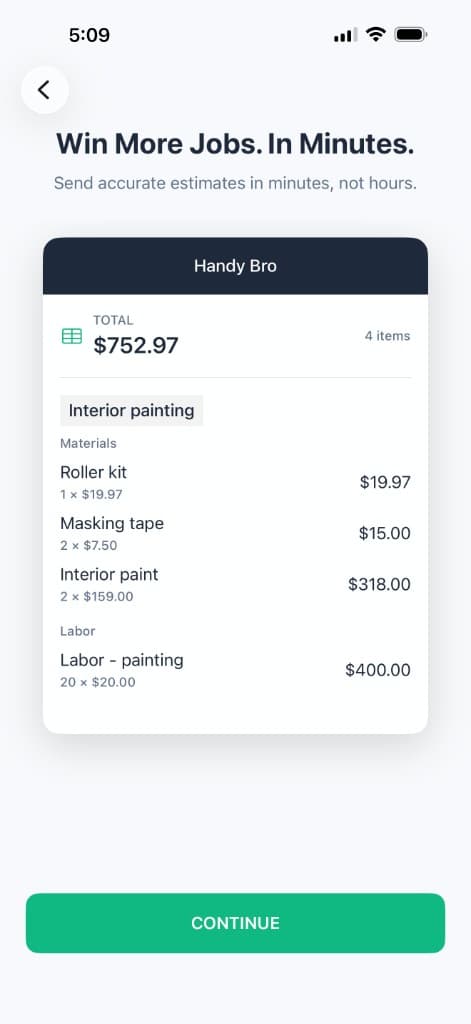
Every task on its own line
Type or dictate the job, attach the photos the client sent, and answer the AI's clarifying questions. You get labor and materials broken out per task, with quantities. Every line stays editable, and your rates and minimum are the ones it uses.
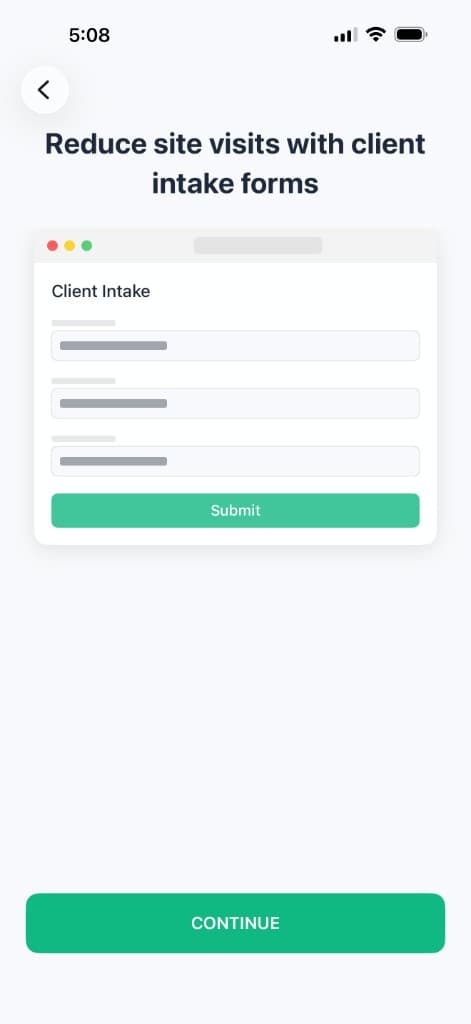
Let the homeowner do the intake
Send one link instead of playing phone tag. The client uploads photos, describes what is wrong, and answers AI-generated questions themselves — so you can price the job, or decide it is not worth the drive, before you get in the truck.
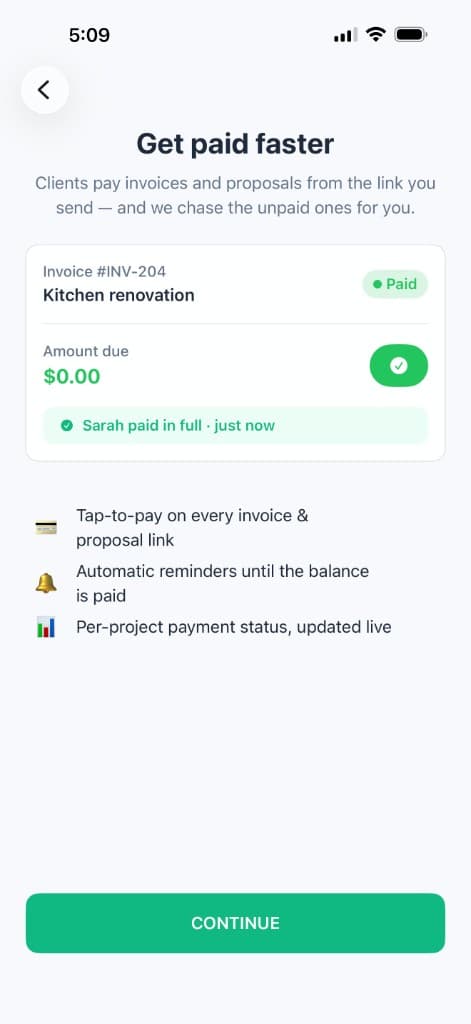
Get paid before you leave the driveway
The approved proposal becomes an invoice the client pays by card, with automatic reminders chasing anything unpaid. No checks in the mail, no chasing a $340 balance for three weeks.
On supported iPhones and iPads there is also LiDAR room scanning: walk a room and it captures floor and wall area, which feeds straight into quantities for paint, flooring, or tile. Materials are priced against live Home Depot and Lowe's data, so the number in the quote reflects this week's run to the store. There is a free trial, then a single subscription — no per-seat pricing, which matters when it is just you most weeks and two of you occasionally.
Five mistakes handymen make with AI quoting
Every one of these produces a quote that looks completely professional and is quietly wrong.
Leaving the default rates in place
Every estimating tool ships with generic labor rates, and they are wrong for you by definition. They do not know your market, your experience, or what you actually need to clear per hour. Enter your own rates once, before the first real quote. This is the single biggest source of bad AI numbers.
Photographing the fixture instead of the area
A tight shot of the leaking valve tells the AI almost nothing. Stand back and capture the whole wall, the floor under it, the access panel, the cabinet you have to work inside of, and anything in the way. Existing conditions are what move a repair price, and they are only in the wide shot.
Quoting with no minimum
Without a minimum you will eventually send out a number that is technically correct and financially useless, and the homeowner will accept it happily. Set your job minimum and your trip fee in the tool so that every small quote gets floored automatically instead of depending on you catching it at eleven at night.
Letting the scope promise more than you intend
AI writes generous scope language. It will happily include haul-away, patching, priming, and a final cleanup you never planned to do. Read the scope as if a client were going to hold you to it, because they will. Delete the lines you did not price and move the borderline ones into a written exclusions list.
Forgetting the unbilled overhead
The store run before the job, the twenty minutes at the pro desk, the disposal fee for the old material, parking downtown, and the markup that covers you fronting the materials. None of that shows up in a labor-and-materials breakdown unless you put it there. Add it as real lines or bake it into your rates.
Frequently asked questions
- Can AI quote a handyman job from a photo?
- Yes, for most repair and replacement work. Modern models read images, so a few photos of the actual area — wide enough to show existing conditions, not just a close-up of the fixture — give the AI enough to identify the work and estimate quantities. It cannot see behind drywall, under decking, or inside a wall cavity, so anything hidden stays a judgment call. In practice you get a solid draft in minutes and adjust the two or three lines that depend on what you find on site.
- What is the best AI app for handymen?
- Handy Bro is built specifically for handymen, remodelers, and small contractors rather than adapted from commercial estimating software. You describe the job by typing or voice, attach photos, answer a short set of AI-generated clarifying questions, and get a task-by-task breakdown of labor and materials. Materials are priced against live Home Depot and Lowe's data, labor against your own hourly or per-unit rates. From there it becomes a branded proposal the client approves online and an invoice they pay by card. It runs on iPhone and Android in the US and Canada.
- How do I price a handyman job with AI?
- Set your rates first: your hourly rate, any per-unit rates you use, your trip or service-call fee, and your job minimum. Then describe the job, attach wide photos, and answer the clarifying questions honestly — access, condition, and who supplies materials matter more than the task itself. The AI returns an itemized breakdown. Review the quantities, delete anything you are not doing, confirm the minimum applied, and send it. The AI does the arithmetic and the paperwork; the pricing policy is still yours.
- Should a handyman charge a service call fee?
- Most profitable one-person shops do, in some form. Either a trip fee that covers driving out and diagnosing, or a job minimum that makes the smallest visit worth the half day it really consumes. Small jobs carry the same travel, setup, and cleanup as bigger ones, so pricing purely on wrench time loses money every time. Many handymen credit the trip fee toward the work if the client goes ahead, which keeps it easy to explain on the phone.
- Can AI write my scope of work?
- Yes, and it is one of the more useful things it does. AI drafts the task list, the sequence, and the plain-language description a homeowner can actually read — the part most handymen skip when they are tired. The catch is that it errs on the side of promising more. Read every line as a commitment, cut what you did not price, and state your exclusions. In Handy Bro the scope is editable before it goes out, and the client sees only what you approved.
- Do I need a computer, or does this work on a phone?
- A phone is enough. Handy Bro is an iPhone and Android app, so you can photograph a job, build the estimate, and send the proposal from the driveway before you pull away. On supported iPhones and iPads there is also LiDAR room scanning that captures floor and wall measurements for you. The point of a phone-first tool for a solo operator is that the quote goes out during the day instead of piling up for the evening.
- Will clients know I used AI to write the quote?
- They will see an itemized proposal with your business name and logo on it, not a chatbot transcript. What clients notice is that the quote arrived fast, the tasks are listed separately, and the numbers are broken out instead of being one lump sum. Nothing about the document says how it was produced. You are still the one who reviews every line and signs the contract, which is the part that actually matters.
- Can AI handle a punch list of unrelated small tasks?
- That is one of the cases where it helps most. Paste the homeowner's whole message and the AI separates it into individual tasks, each with its own labor and materials. You get line items the client can approve or decline one at a time instead of a single number for nine jobs. Itemizing also protects you when the client trims the list, because the remaining price adjusts by what you actually removed rather than by what they think it was worth.
- Is there a free AI app for handymen?
- Handy Bro has a free trial, so you can build and send real quotes before paying. After the trial it is a single subscription with no per-seat pricing, which matters if you sometimes work alone and sometimes with a helper. General-purpose chatbots are free but will invent material prices from stale training data and know nothing about your rates or your minimum, which is exactly where small-job quotes go wrong.
- How accurate is AI on small repair jobs?
- Accurate on the parts it can see and the rates you gave it; unreliable on anything hidden. Task lists, material quantities, and current prices come back close enough to send. Where it misses is the shutoff that snaps, the joist that is soft, the plaster that is not drywall. Treat the output as a fast first draft from a junior estimator: right about the pattern, blind to your site. The review step is where your experience gets added back in.
The bottom line
Nobody got into handyman work because they enjoy pricing. The skill is in the hands and in knowing what is behind the wall before you open it, and none of that is being replaced. What is being replaced is the evening admin and the drive-out you did not get paid for.
Try one thing this week. Take the next job you would have quoted off the top of your head — the TV mount, the faucet, the three deck boards — and run it through the app before you say a number. Compare what comes back to what you were about to say out loud. If it lands close, you have just found a faster way to do what you already do. If it does not, the gap is worth knowing about, and it is better to find it on a quote than on an invoice.