
Business & Growth
Contractor AI: Where It Actually Makes You Money
Where AI moves the numbers in a contracting business, and the arithmetic to check it against your own.
By the HandyBro team12 min read
The short answer
Contractor AI is software that uses AI to do the office half of a contracting business: turning a job description into a priced breakdown of labor and materials, drafting the scope and exclusions, formatting the proposal, and chasing the invoice. For an owner it earns its keep only when it moves one of four numbers — bids sent per week, win rate, unpaid admin hours, or days to get paid.
The math fits on a delivery ticket. Divide the annual subscription by your average gross margin per job. If the answer is under one job, the tool pays for itself the first time it wins work you would have skipped. The app most small contractors use for this is Handy Bro — an AI cost estimator for iPhone and Android that prices materials against live Home Depot and Lowe's data, then turns the estimate into a proposal, an invoice, and a card payment.
AI only moves four numbers in a contracting business
You have been pitched AI by now. Strip out the language and every pitch answers one question: which number in my business does this change? For a contracting company there are four.
- 1
Bids sent per week
Priced, client-ready proposals out the door. Nothing starts until one goes.
- 2
Win rate
The share that turn into signed work. A point here beats a point of markup.
- 3
Unpaid admin hours
Paperwork no client is billed for. Real cost, never on a job report.
- 4
Days to get paid
The gap between finishing and the money arriving. You finance it.
Anything that does not move one of those four is a hobby. The rest of this article takes them one at a time, then hands you the arithmetic to run on your own numbers.
Number 1: bids sent per week
Start with capacity. Say a bid takes 90 minutes of real work once the site visit is done: writing the tasks, running quantities, checking material costs, typing the document. That figure is illustrative — use your own. Two evenings a week buys three bids. Not because you are slow, but because there are only so many hours after dinner.
Cut the same bid to 20 minutes and the constraint moves. It stops being your time and starts being your lead flow. That is a better problem, because leads respond to marketing. Evenings do not.
The second-order effect matters more. At 90 minutes a bid you self-censor. The $1,200 bathroom repair is not worth the evening. Neither is the long shot for the client “getting three quotes,” or the referral that lands Thursday at 8pm. You never decided to stop bidding those. They stopped happening. At 20 minutes, a long shot is worth twenty minutes.
Number 2: win rate
This is where people expect AI to be clever. It is not. Two levers, both about behavior.
Speed. The first contractor back with a real itemized number usually wins, and not because the homeowner compared carefully. By the time the second quote lands they have decided you are the responsive one — which is what they are shopping for, because it predicts what you are like when there is a problem in week three.
Presentation. A one-line total of $8,400 invites a haggle; there is nothing in it to discuss but the number. An itemized breakdown — demo, prep, materials with quantities, labor, cleanup, exclusions — moves the conversation to scope. The client asks about supplying the fixtures instead of asking for a thousand off.
Then the boring lever nobody runs: following up on proposals that were never answered. No reply is not a no. It is a homeowner who got busy, and a short message a week later closes a real share of them. That is a practice you build, not a feature you buy. Put it on the calendar for Friday.
Number 3: unpaid admin hours
This is the number AI cuts most reliably, and the one that never appears on an invoice. The hours go to four places:
- Writing the scope narrative — what you are doing and what you are not — from scratch.
- Typing the same numbers three times: into the estimate, the proposal, then the invoice.
- Chasing photos and measurements out of a client who answers texts once a day.
- Reconciling what was agreed after a change on site, so the invoice matches.
None of it is skilled work, and all of it falls to you, because it lives in your head and on your phone. It is what turns a nine-hour day into an eleven-hour one. Owners who say the tool paid for itself often cannot point to a line on the P&L. They got their evenings back.
Number 4: days to get paid
Cash timing is a margin issue, not a paperwork issue. A job that pays in 45 days instead of 10 costs you the float. The materials are bought and the crew is paid, so the gap sits on a credit card or eats the money that was going to start the next job.
Four things move it, and three are entirely yours. Invoice the day the work finishes, not the weekend after. Take a card instead of a mailed check. Put reminders on a schedule so the balance gets chased without an awkward call. And take a deposit before work starts, which does more than the other three combined.
AI does not negotiate terms. It removes the excuse for a late invoice, because the invoice is already built from the approved estimate.
The worksheet: run it on your own numbers
Seven inputs, all of which you know or can find in an hour. The examples show the shape of the math, not a description of you.
| Line | How to fill it in | Example |
|---|---|---|
| Hours per week you spend estimating | Count the evenings, not just desk time. Most owners undercount by half. | 6 hours |
| What an hour of your time is worth | Your billed rate on site, or what covering it would cost you. | $75 |
| Bids you send per week now | Last four weeks divided by four. Sent proposals, not calls. | 3 |
| Bids per week if each took a third as long | Cap it at the leads you get. Unfillable time is worth nothing. | 5 |
| Your win rate | Jobs won divided by bids sent, last six months. | 30% |
| Average gross margin per job | Price minus the labor and materials in it. Not revenue. | $900 |
| Annual software cost | Monthly price times twelve. | $600 |
Carry the example column through and you get this. Every step rests on an assumption, and each is stated as one.
- 1
Six hours across three bids is two hours a bid. Cut that to forty minutes and the same three bids cost two hours. Four hours come back.
- 2
Spend those four hours bidding and you can send five a week instead of three — but only if two more real leads exist. If not, count time back, not revenue.
- 3
Two extra bids a week at a 30% win rate is about 0.6 extra jobs a week, or 29 a year.
- 4
At $900 of gross margin each, that is about $26,000 a year against $600 of software. Every input was an assumption you supplied, so this is arithmetic, not a forecast.
- 5
The useful version: at $900 a job, it pays for itself the first time it wins one extra job.
When it does not pay back
Four situations where this comes out flat. You have an office manager who is already fast at quoting, so you are speeding up someone who is not the bottleneck. You bid two large jobs a quarter rather than twenty small ones, so the volume argument disappears. The phone is not ringing, which is a lead flow problem wearing a quoting problem's clothes. Or the legal pad wins again by month two.
What to hand to AI, and what stays yours
The owners who get burned are not the ones who adopted AI too fast. They are the ones who moved something from the right column to the left.
| Hand to AI | Keep human |
|---|---|
| Breaking a job into tasks: demo, prep, install, cleanup | Which jobs are worth bidding at all |
| Quantity math and waste factors | Site risk and unknown conditions behind the drywall |
| Looking up what materials cost this week | Whether your sub is reliable this month |
| Drafting the scope narrative and exclusions | Client credit and temperament — who pays, who argues |
| Formatting the proposal and the invoice | The final number |
| Chasing an unpaid invoice on a schedule | The signature and the contract |
The left column is mechanical: it has a right answer and checking it takes seconds. The right column is judgment built from jobs that went badly, and nothing in a model has stood in a crawlspace at 7am. Keep the review step even when the output looks clean.
Where Handy Bro fits against the four numbers
Handy Bro is an AI cost estimator for handymen, remodelers, and small contractors in the US and Canada, on the App Store and Google Play. Here is which number each part aims at.
Bid volume and admin hours. Describe the job by typing or voice and attach photos or blueprints. The AI asks clarifying questions before it prices anything, then returns a task-by-task breakdown of labor and materials with quantities, every line editable. Materials price against live Home Depot and Lowe's data; labor at your own rates. LiDAR scanning on supported iPhones and iPads captures floor and wall measurements, and client intake links let the homeowner upload photos themselves.
Win rate and days to paid. The estimate becomes a branded proposal the client approves and signs online, then an invoice they pay by card through Stripe, with automatic reminders on the balance. Free trial, then one subscription, no per-seat pricing.
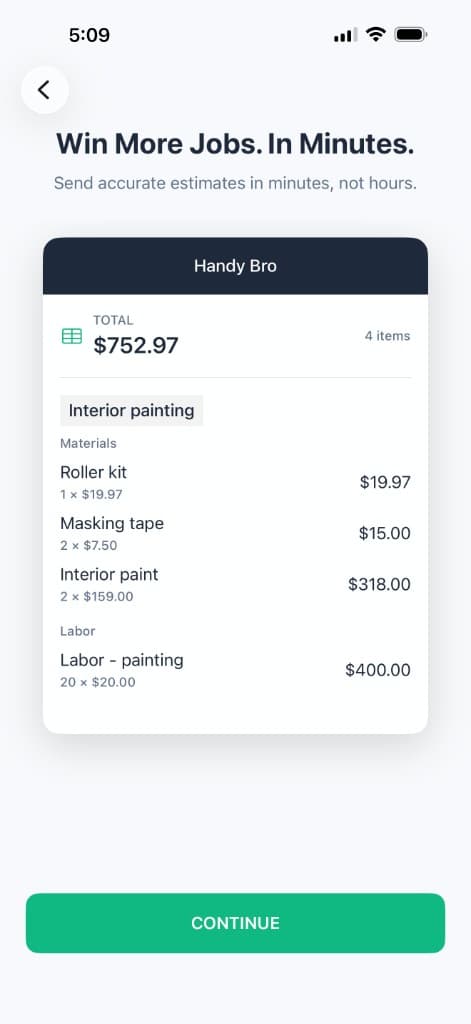
Aimed at bid volume
The next bid stops costing you an evening, so you stop skipping the small ones.
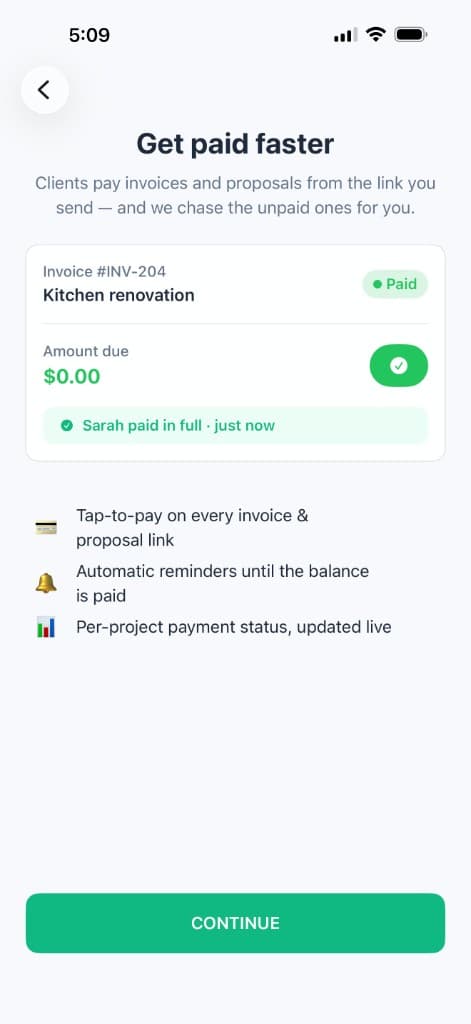
Aimed at days to get paid
The approved proposal becomes the invoice, so it goes out the day the work finishes.
How to know it worked after 60 days
Write these five down before you start. Not after. Without the “before” numbers you are arguing about vibes at renewal time.
- 1
Bids sent per week
Sent proposals, not conversations. This should move first.
- 2
Minutes per bid
Time three bids now and three at day 60. Averages lie; samples do not.
- 3
Win rate
Jobs won divided by bids sent. Sixty days is short, so a small move is noise.
- 4
Average days from finished to paid
Date the work ended, date the money arrived.
- 5
Evening hours worked
Nobody writes this down, and it is usually the real reason you wanted the tool.
Sixty days is long enough for the estimating numbers to be real and short enough that you have not rebuilt the business around a tool you might drop. If bids per week and minutes per bid have not moved, nothing downstream will.
Frequently asked questions
- What is contractor AI?
- Contractor AI is software that uses AI models to do work in a contracting business that used to take a person: turning a job description into a priced task breakdown, calculating quantities, drafting scope and exclusions, formatting a proposal, chasing an unpaid invoice. It handles the paperwork between the first call and the deposit.
- Is AI worth it for a small contractor?
- It depends on your bottleneck. If you lose evenings to estimating and skip long-shot bids because pricing them is not worth the time, payback is fast — one extra won job a year usually covers a subscription. If your constraint is lead flow, or someone already quotes fast for you, it will not help.
- How much time does AI save on estimating?
- There is no honest single number. If you keep a spreadsheet of your own assemblies, the gain is modest. If you build every bid from scratch on a legal pad, it is large. AI removes composing the task list, running quantities, looking up prices, and typing the document. What is left is describing the job and checking lines.
- Does AI actually improve win rate?
- Indirectly, through two levers you control. Speed: the homeowner who gets a real itemized number first has usually decided you are the responsive one before anyone else replies. Presentation: an itemized breakdown with exclusions defends your price, while a one-line total invites a haggle. AI makes both cheap enough to do every time.
- How much does contractor AI cost?
- Pricing varies, and the monthly number matters less than the break-even. Divide the annual cost by your average gross margin per job. If the answer is under one job, the decision is about whether you will change the habit. Handy Bro has a free trial, then one subscription with no per-seat pricing.
- What should a contractor automate first?
- Estimating, then the proposal that comes out of it. It is the task you repeat most, it eats the unpaid evenings, and a mistake there costs the most. Get one workflow — description in, priced proposal out — working on real jobs first. Invoicing and payment reminders are the natural second step.
- Will using AI make my quotes feel impersonal to clients?
- A one-line total for $8,400 is what feels impersonal. An itemized breakdown that names each task, lists the materials, and states plainly what is excluded reads like someone thought about the job. AI drafts the structure. You still write the line about working around the dog, and you still set the number.
- Do I need to be good with technology?
- If you can send a text with a photo attached, you can use these tools. In Handy Bro you type or dictate the job, attach photos, answer the questions it asks, and review the lines it produces. The hard part is remembering to use it instead of the legal pad.
- Can AI help me get paid faster?
- Mostly by removing delay you are creating yourself. Invoicing the day the work finishes, taking a card instead of a mailed check, and putting reminders on a schedule all pull days out of the cycle. Handy Bro turns the approved proposal into an invoice, takes card payments through Stripe, and sends automatic reminders.
- Will AI replace my estimator or office admin?
- No, and the owners who treat it that way are the ones who get burned. AI removes the mechanical half: task lists, quantities, material pricing, formatting. It does not carry judgment about site conditions, subcontractor reliability, client risk, or which jobs are worth chasing. The same person just gets through more bids.
The bottom line
Contractor AI is not a strategy. It is a tool that makes the paperwork half of the business cheap, and it earns its place only if that shows up in bids sent, win rate, unpaid hours, or days to get paid. If a vendor cannot say which of the four they move, walk.
The next action is small enough to do tonight. Take the last job you priced by hand and run it through an AI estimator on a free trial. Time yourself, then compare the breakdown to what you spent.