
Industry Trends
AI in Construction: Where the Industry Actually Stands
Who is actually getting value from AI, why adoption stalls in this industry specifically, the contract questions nobody puts in the brochure, and where it goes next.
By the HandyBro team12 min read
The short answer
AI in construction is real, and it is split in two. On large capital projects, artificial intelligence is used for document search, schedule risk analysis, and camera-based safety and progress monitoring. It works, and it moves at the speed of enterprise procurement. At the small residential end, one thing is in daily use: estimating on a phone — describe a job, get a task-by-task breakdown of labor and materials, send a proposal.
Adoption stalls for structural reasons rather than stubbornness: records that were never clean enough for the promised model, per-seat pricing that multiplies across a field workforce, and crews who will not open a second app. The tools that get used at the small end are shaped around those facts — apps like Handy Bro, which run on the phone a contractor already carries and cost one subscription instead of a seat per person.
The conference and the jobsite
At a construction technology conference, artificial intelligence is finished business: models read the drawings, predict the schedule slip, and catch a hazard on camera before the foreman turns around. Walk onto a jobsite the next morning and the software in use is a group text, a spreadsheet, and a price book from the spring.
The usual way to close that gap is to quote an adoption survey. This article will not. Published numbers disagree badly enough to support whatever position you walked in with, because each study defines “using AI” differently — one counts a firm where somebody opened a chatbot once, another counts only production systems.
So look at what you can verify: which products actually ship, what they require before they work at all, and what they cost per user. Pricing is the most honest document a software company publishes. It says who the vendor believes can pay, and therefore who is really using this.
Three different industries wearing one name
Construction gets discussed as one industry because everyone in it wears boots. The word covers a firm building a hospital, a builder putting up thirty houses a year, and a two-person crew replacing a deck.
| Who you are | AI that is actually running | What is blocking the rest |
|---|---|---|
| Enterprise GCs and owners on large capital projects | Plain-language search across specs and submittals, schedule risk analysis, camera-based safety and progress monitoring. All of it needs a model, a network on site, and someone whose job is running it. | Procurement, not capability. A pilot clears IT, security, legal, and an owner's standards before it reaches a project, which has usually moved on by then. Slow rather than absent. |
| Mid-size builders and specialty trades | Estimating and takeoff assistance, proposal drafting, document handling — nearly all of it in the office. Field use stays thin. | Nobody to run it. Jobs are big enough that a bad number hurts, but the person who would evaluate the tool is the estimator bidding four jobs this week. |
| Small residential contractors, remodelers, and handymen | Estimating on a phone: describing a job, pricing labor and materials, sending a proposal from the truck. Little else. | Money and seats. The fastest payback in the industry sits with the least cash, so anything priced per user or built for a desktop never lands. |
The pattern is uncomfortable. The segment with the most capacity to adopt has the least urgent problem, and the one with the most urgent problem has the least capacity to pay. A large general contractor absorbs a bad estimate across a portfolio; a remodeler absorbs it out of the year. So shape matters as much as intelligence: at the small end, the tool has to arrive on a phone and work on the first job.
Why adoption stalls in construction specifically
Every industry complains that software is hard to adopt. Construction has specific reasons, and they are structural rather than cultural.
- 1
The data is not clean enough for the model that was promised
Most pitches assume accurate drawings, a model that matches the building, and cost history with real hours in it. What exists is a drawing set that stopped matching the built condition in the second week of framing, and cost history that lives in an estimator's head.
- 2
Per-seat pricing multiplies painfully across a field workforce
Per-user pricing was designed for offices, where the headcount touching the tool is small and fixed. A contractor's is neither. So the company buys a few seats, and a tool only some people have is a tool nobody depends on.
- 3
The crew will not adopt a second app
The phone in a carpenter's pocket already holds the group text, the payroll app, and the supplier app. Adding one more, to be opened with dirty hands while the client stands there, is a losing proposition.
- 4
Nobody owns the outcome
The pilot belonged to preconstruction, or to whoever went to the conference. The field never agreed to it and was never asked. When it ends nobody can say whether it worked, because nobody wrote down what working would look like.
- 5
The industry is project-based, so learning does not compound
A factory that improves a process keeps the improvement. A project assembles a team of subs, runs, and dissolves, and whatever that crew learned walks off site with them. Every job restarts the adoption curve with new people.
Only the first is about technology. The rest are about money, attention, and ownership — which is why a good tool can fail inside a company and succeed in a one-truck operation where one person has to agree.
The pressure actually driving this, and it is not novelty
The force pushing AI into construction is not a vendor roadmap. It is that the people holding the estimating knowledge are leaving.
An experienced estimator carries a great deal of undocumented judgment: that this architect's plans run light on demo, that a rehab on these streets finds rot behind the tub, which subs pad and by how much. None of it is written down. It leaves with the person.
The people replacing them are fewer and greener, and they learn on jobs that do not slow down to teach. Residential economics will not support the traditional answer either: a commercial firm can carry an estimating department, and a two-truck operation prices work at night, in the ninth hour of the day.
So the honest framing is this: in most small firms, AI is not substituting for a worker. It is substituting for the specialist they never had, or the one who just retired.
Contracts, liability, and the part nobody puts in the brochure
An AI-produced number goes into a document a client signs, which makes it a contract question and an insurance question as much as a software one. Six worth resolving at your own desk.
Who carries the loss when an AI-assisted estimate underprices a fixed-price job?
You do, in almost every case. The contract is between you and your client, and the tool's terms will disclaim responsibility for its output. Keep the contingency you would have carried doing the math by hand.
Does your contract cover scope generated from photos?
An estimate built from photos is not a site inspection, and the paperwork should say so. State that pricing reflects visible and described conditions, list your exclusions, and carry an allowance for concealed conditions.
Do you tell the client you used AI?
There is generally no requirement to. The risk is surprise, not the tool: if the job goes badly and the client learns afterward, the concealment does the damage.
What does your carrier expect?
General liability and errors-and-omissions coverage can turn on how you represent your process, especially if you do anything design-adjacent. Ask your broker whether AI-assisted scoping changes your policy.
Where do the plans, photos, and addresses go?
You are uploading a client's address, their floor plan, and pictures of the inside of their house. Find out where it is stored and whether it trains a model. A vendor that will not answer in writing is telling you something.
What did you pass down to your subs?
If you hand a sub a quantity that came out of an AI takeoff, decide in writing who absorbs the difference when the field count runs higher. Check before the drywall shows up short.
None of this is legal advice. Contract wording and insurance coverage vary by state, trade, and policy, and should be reviewed by your own attorney or insurance broker.
None of it is a reason to stay out. These are answerable questions and most take an afternoon. The industry worked through a similar list when signatures moved online, and the firms that got hurt were the ones that never read the terms.
What changes next
Predictions with dates attached are usually wrong, so these are directional bets with the reasoning included.
- 1
AI-assisted estimating becomes table stakes
Returning a clean itemized estimate the same day is an edge now. It will not stay one. When every bidder can do it, the advantage moves back to better rates, better subs, and knowing what a house will do when you open the wall.
- 2
Live material pricing becomes an expectation
A cost book updated last spring is hard to defend to a client checking prices on their phone in the aisle. Estimates built on current supplier data become the normal case.
- 3
Homeowners arrive with their own AI estimate
This is the one to prepare for, and it has already started. Clients ask a chatbot what a kitchen should cost, then bring that number to you.
- 4
Vision-based documentation moves down to the phone
Capturing site condition week to week currently means buying hardware, which restricts it to large projects. That capability keeps getting cheaper and keeps moving toward the device everyone already carries.
- 5
Insurers and lenders start asking how the number was produced
Once enough contracts are priced with assistance, the parties underwriting the risk will want to understand how. Nothing about this is imminent; it is the direction everything above points.
The third one deserves more than a line. Handle the homeowner's number the way you would handle a competitor's bid you think is wrong: do not argue with it. Put your itemized breakdown next to it and go line by line — labor hours, quantities, the discontinued tile, the panel that will not carry another circuit. A total with nothing behind it loses to a breakdown almost every time.
What this means if you run a truck and a crew
Most of this article describes other people's problems. You have no preconstruction department and no procurement cycle. You have the fastest payback in the industry, sitting in the unpaid hours you spend pricing work at night, and the least money to fix it.
That narrows what can work. The tool has to run on the phone you already carry, cost one subscription instead of a seat per person, and be useful on the first job. Handy Bro is built for that end of the market: an AI cost estimator for handymen, remodelers, and small contractors in the US and Canada, on the App Store and Google Play.
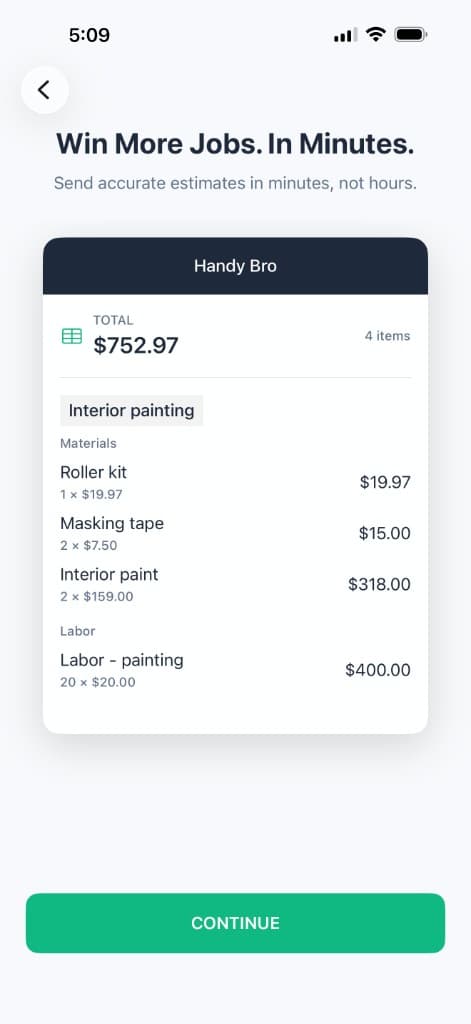
A breakdown, not a number
Describe the job by typing or talking, attach photos or blueprints, and answer the questions the AI asks before it prices anything. Back comes a task-by-task breakdown of labor and materials, every line editable.
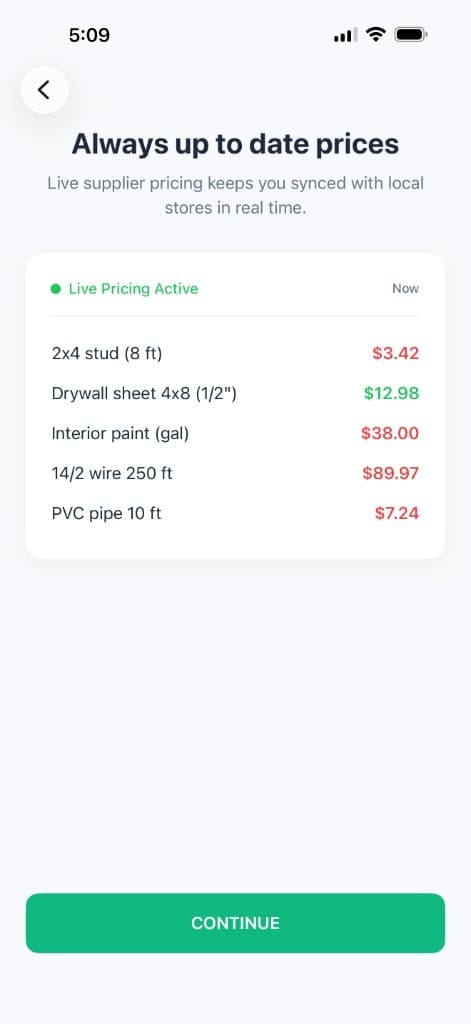
Prices from this week
Materials are priced against live Home Depot and Lowe's data, labor at your own rates, hourly or per unit. That is the difference between a defensible estimate and a guess.
On supported iPhones and iPads you can scan a room with LiDAR for floor and wall measurements, and an intake link lets a homeowner upload photos and answer AI-generated questions before you drive out. The estimate becomes a branded proposal the client signs online, then an invoice they pay by card. Free trial, then one subscription rather than a seat per person.
Frequently asked questions
- How is AI used in construction today?
- Unevenly. Large capital projects use document search, schedule risk analysis, and camera-based safety and progress monitoring. Mid-size builders mostly use estimating support and proposal drafting in the office. At the small residential end it is nearly all estimating: describe a job on a phone, get a priced breakdown, send it.
- How many construction companies use AI?
- Nobody can tell you honestly. Published surveys disagree wildly because each defines use differently: some count a firm where one person tried a chatbot, others count only production systems. What is observable helps more. Tools priced per project assume a customer with staff; phone apps sold as one subscription assume a customer with none.
- Is AI in construction just hype?
- Parts of it. That AI is running construction projects is hype. That it turns a described scope, photos, and your labor rates into a priced task list in minutes is not. A useful filter: if the product produces a draft for you to review, it is real. If it claims to decide, be skeptical.
- Will AI take construction jobs?
- Not the trades. Nothing in this wave frames a wall, pulls wire, or sets tile. The exposure is office work that turns information into documents: takeoff, estimating support, proposal writing. Even there, the pattern in small firms is substitution for a role nobody ever filled.
- Who is liable if an AI estimate is wrong?
- You are, in almost every case. The contract is between you and your client, and the software's terms disclaim responsibility for its output. Treat the estimate as a draft you are accountable for: review every line, keep your contingency on fixed-price work, and have your own attorney check the wording.
- Do I have to tell clients I used AI?
- There is generally no requirement, and clients no more expect it than they expect to hear which spreadsheet you used. The risk is surprise, not the tool. If a job goes badly and the client learns afterward, the concealment does the damage. One sentence handles it.
- What if a homeowner brings me their own AI estimate?
- Expect it more often, and do not argue with the number. Put your itemized breakdown beside it and go line by line: labor hours, material quantities, the discontinued tile, the panel that will not carry another circuit. A breakdown beats a bare number almost every time.
- Is AI in construction only for big companies?
- It used to be. Site cameras, model-based progress tracking, and schedule risk analysis are still bought by large projects with staff to run them. But estimating moved onto phones and is priced like an ordinary subscription, which puts it within reach of one truck.
- What is the biggest barrier to AI adoption in construction?
- No single one, but the most underrated is that nobody owns the outcome: the pilot belonged to whoever went to the conference, the field was never asked, and nobody defined success. Close behind are dirty data, per-seat pricing across a field workforce, and crews who will not adopt a second app.
- Where should a small contractor start with AI?
- Estimating, and only estimating, on one job. Take a project you already finished and know the real cost of, run it through an AI estimator, and compare line by line against what you spent. That shows where it runs high or low before it touches a live bid.
The bottom line
The industry's AI story is bifurcated. At the expensive end — capital projects, site monitoring, schedule risk, document intelligence — the technology is real and so are the results, and it advances at the speed of procurement.
At the cheap end, estimating on a phone is available today and pays for itself the first time it catches a quantity you would have missed. That is where a small firm's payback is — not the version that gets a keynote, but the one running this morning.