
Client Communication
Client Communication for Contractors: What to Say and When
Clients rarely complain about craftsmanship. They complain about not knowing what is happening. Here are the messages that keep a job calm, from the first inquiry to the final invoice.
By the HandyBro team13 min read
The short answer
Good contractor client communication comes down to four habits: reply within the hour, set expectations in writing before work starts, give a short update on a predictable rhythm, and tell the client about problems the same day you find them — with options attached. Anything involving money or scope goes in writing. Almost every dispute in residential contracting begins with a silence, not with bad workmanship.
The written half gets much easier with the right tool. Handy Bro sends the itemized proposal with a scope the client can actually read, records what they approved, turns approved work into an invoice, and chases unpaid balances automatically — so the awkward conversations happen through documents instead of through you.
Most unhappy clients are not unhappy about the work
Think about the last job that went sideways. The odds are the tile was fine, the framing was fine, and the thing that soured it was a week when nobody came and nobody explained why, or a cost that appeared on the final invoice having never been discussed.
Homeowners are in an unusual position when they hire a contractor. They are spending a large amount of money on something they cannot evaluate, in their own home, with strangers, and they have all heard the horror stories. That anxiety looks like a difficult personality when it is really an information problem. Give people information they did not have to ask for and most of the difficulty evaporates.
The good news is that this is the cheapest edge available to a small contractor. You may not be able to outbid a bigger company or match their crew size, but you can absolutely out-communicate them, and clients notice it immediately because they are so used to the opposite.
The first reply, and what it has to do
The first message sets the tone for everything after it, and it is also a sales document whether you think of it that way or not. Four jobs, in about four sentences.
- 1
Confirm you do this work
One sentence that names their actual job back to them. “Yes, we do bathroom tile — including the shower pan.” Homeowners are often unsure whether they even called the right trade, and removing that doubt is the first thing your message should do.
- 2
Show you read what they sent
Reference a specific detail from their photos or message. It takes four extra words and it separates you from every contractor who replies with a generic greeting. It is also the moment the client decides you are paying attention.
- 3
Ask no more than two questions
Ask only the questions that change the price or decide whether you take the job — usually the address and one scope question. A ten-question interrogation as a first reply gets abandoned. Everything else can come later or through an intake link.
- 4
Commit to a specific next step and time
“I can come by Thursday morning, or if you send a couple more photos I can price it today.” Never end a first reply with “let me know.” You are the one who should be proposing the next move.
Speed matters as much as content here — a good reply tomorrow loses to an adequate one in ten minutes. The full argument for that, and what it does to your win rate, is in how to win more bids.
Messages for every stage of a job
Steal these and make them sound like you. The point is not the exact wording; it is that you never have to compose a difficult message from scratch at the end of a twelve-hour day, which is when the unsent message usually happens.
New inquiry, and you want the job
Hi Sarah — thanks for reaching out. Yes, we handle deck repairs like this, and from your photos it looks like the boards near the steps are the main issue. Two quick things: what is the property address, and are you hoping to have it done before a specific date? I can either swing by Thursday morning or, if you can send one wide photo of the whole deck, get you a price today.
New inquiry, and you cannot take it
Hi Mark — thanks for thinking of us. That one is outside the area I cover, so I would not be doing you any favors taking it on. Dan at Northside Carpentry works over there and does good work — his number is below. Best of luck with the project.
Quote sent
Hi Sarah — your proposal is in your inbox. It is itemized so you can see where everything lands, and the exclusions are listed at the bottom so there are no surprises. Happy to walk through any line on the phone. The price holds for 30 days, and my next opening is the week of the 14th.
Follow-up with new information
Hi Sarah — no pressure on the deck, just a heads-up: I finished a similar one on Maple last week and put a photo below so you can see the finish. Also, the composite you were considering is on a two-week lead time now, so if that is the direction you want, we would need to order soon.
The day before you start
Hi Sarah — we are all set for tomorrow. I will arrive between 8 and 8:30, the noisy part is the first two hours, and I will need to get to the outside faucet and the driveway for the trailer. If anything needs moving off the deck, tonight is the time. Anything you want me to know before we start?
Running late
Hi Sarah — a job ran over this morning and I am about 90 minutes behind. I will be there by 10:15 and will still finish today's work as planned. Sorry for the shuffle — I would rather tell you now than have you wondering at 8:30.
You found something unexpected
Hi Sarah — pulled the boards up and two of the joists underneath are soft where the water has been sitting. Photos attached. Leaving them means the new decking will fail in a few years, so my recommendation is to sister those two joists while everything is open. That adds about half a day and the materials — I will send a change order with the exact figure in the next hour. Nothing further happens until you approve it.
End of a work day on a longer job
Hi Sarah — end of day one: demo is done, joists are sistered, and the new boards are on site. Tomorrow is decking and the first sand. Photos attached. Still on track for Friday.
Job complete
Hi Sarah — all finished and cleaned up. The stain needs 24 hours before you put furniture back, and I would keep the grill off it until Sunday. Everything I did is covered by a two-year workmanship warranty. Your invoice is attached and can be paid by card from the link. It was a pleasure — if you know anyone who needs similar work, I would appreciate you passing my name along.
Invoice reminder, first one
Hi Sarah — just a friendly nudge that the invoice from the deck job is still open. Payment link is below and takes about a minute by card. Let me know if you need anything adjusted on it.
Invoice reminder, firmer
Hi Sarah — the deck invoice is now 30 days past due. I would like to get this closed out this week. If there is an issue with the work or the amount, tell me and I will sort it. Otherwise, can you let me know what day payment will go out?
Notice what the good ones have in common: a specific time, a specific action, and no hedging. “I will be there Thursday” instead of “I should be able to get to it this week.” Vague language feels safer to write and is the single biggest source of client frustration, because it transfers your uncertainty onto someone who cannot do anything with it.
Setting expectations before the first nail
Ten minutes before you start saves hours later. Walk the client through what the next days actually look like — not the scope of work, which is in the contract, but the experience of living alongside it.
- Working hours, which days you will be on site, and which days you will not — including the ones where you are waiting on an inspection or a delivery.
- What access you need: driveway, water, power, a gate left unlocked, a dog kept inside.
- What the house will be like to live in — dust, noise, whether the kitchen is usable, when the water goes off.
- Who to contact, and who is on your crew. Names of the people who will be walking through their home.
- How changes get handled: in writing, priced, approved before the work happens, no exceptions.
- Payment schedule and methods, restated even though it is in the contract.
- The one thing most likely to go wrong on this job, and what happens if it does.
That last item is the one professionals include and amateurs skip. Naming the likely problem in advance — “on a house this age there is a fair chance the shutoff will not hold, and if that happens here is what we do” — converts a future crisis into a prediction you already made. It costs nothing and it buys an enormous amount of trust when the thing actually happens.
Then follow it with the same rhythm every day: arrive when you said, send one message at the end of the day on anything longer than two days, and leave the site tidy. Predictability is the whole product as far as a nervous homeowner is concerned.
Delivering bad news
Every job has at least one. A delay, a hidden condition, a back-ordered material, a mistake. How you deliver it determines whether the client tells people you were honest or tells people you were a nightmare.
- 1
Tell them the same day you know
The instinct is to wait until you have a solution. Do not. A client who learns about a problem on Monday is a partner; a client who learns about it on Thursday after noticing it themselves is an adversary. Speed is what makes it a professional judgment call rather than something you were hiding.
- 2
Lead with the fact, not the excuse
“The tile you chose is back-ordered until the 22nd” before any explanation of the supply chain. Clients absorb the fact first and everything after it is noise. Explanations that arrive before the news read as excuses no matter how good they are.
- 3
Bring options, not just a problem
Two or three paths, with the cost and time impact of each, and a recommendation. “We can wait, we can substitute this comparable tile that is in stock, or we can start the other rooms and come back. I would substitute.” You are the expert; they hired you partly to decide.
- 4
Own the part that is yours
If you measured wrong, say you measured wrong and how you will fix it at your cost. Contractors dramatically overestimate the damage of admitting a mistake and underestimate the damage of a client who suspects one is being covered up.
- 5
Put it in writing after the conversation
Call or tell them in person, then send a short written summary of what you discussed and what was decided. That is not distrust; it is the record that keeps you both honest in six weeks when memories differ.
One thing to avoid entirely: never deliver bad news and a price increase in the same breath without photos. Show them what you are looking at. A picture of a rotted joist ends an argument before it starts, and it is the difference between a change order that gets signed and one that gets disputed.
The change-order conversation
Unpaid final invoices in residential work usually trace back to a change that was agreed verbally, in the middle of a busy day, by two people who remembered it differently. The fix is procedural, not personal.
Say the policy out loud on day one, as a normal part of how you work: anything outside the written scope gets priced in writing and approved before it happens. Framed that way it protects the client as much as you, and nobody objects to it. What people object to is the first change order arriving as a surprise in week three.
When the moment comes, keep the message to four things: what changed, why it needs doing, what it costs, and what it does to the schedule. Attach a photo. Then stop and wait for approval — the temptation to keep working while the client thinks about it is exactly how you end up doing unbillable work.
Be honest about which changes are discoveries and which are requests. A soft joist you could not have seen is a discovery, and clients accept those readily when they are shown the evidence. Something you should have caught during the estimate is on you, and saying so is worth more over time than the few hundred dollars you would recover by arguing.
Difficult clients and where the line is
Most difficult behaviour has a cause you can address. A few things do not, and knowing the difference keeps you from either bending forever or blowing up a job that was salvageable.
| Situation | How to handle it |
|---|---|
| Scope creep, one small favour at a time | “While you are here, could you just...” is how a profitable job becomes a break-even one. Have a standard answer ready: “Happy to — let me add it to the list and send you the price tonight.” Cheerful, immediate, and priced. Do the genuinely two-minute favours for free and be transparent that you are doing them, because unlogged generosity is invisible and endless. |
| The client who negotiates every line | Answer once, with substance, then hold. Offer scope changes instead of discounts — you can remove the haul-away or they can supply the fixtures. If the negotiating continues after the contract is signed, that is a signal about how the final payment will go, and it is fair to slow down and reconfirm terms before continuing. |
| The daily phone call about nothing | Anxiety, usually, not distrust. The cure is a scheduled update: a short end-of-day message with a photo and tomorrow's plan. Clients who receive information on a rhythm stop chasing it. Say it explicitly: “I will send you an update every evening, so you will always know where we are.” |
| A family member with opinions | A brother-in-law who did some construction once shows up midway with concerns. Do not get defensive and do not argue technique in front of the client. Explain your reasoning calmly, offer to walk them through it, and confirm the decision with the person who signed the contract. Written scope is what settles this quickly. |
| Payment is slow and the excuses are soft | Escalate on a schedule rather than on emotion: friendly reminder, firmer message with a date requested, then a formal notice referencing your terms. Keep every message factual and unemotional — anything you write can end up in front of a third party. Stop work if terms allow it and the balance is real, and know your local lien deadlines before you need them. |
| The client you should not have taken | Sometimes the honest move is to end it. If the relationship is genuinely broken, propose a clean exit: bill for completed work, document the state of the site with photos, and hand over what is needed for someone else to continue. Do it politely and in writing. One unpaid morning is cheaper than three more weeks of it. |
Two rules for the hard end of that table. Write every message as though a third party will read it later, because on the worst jobs one will. And never respond to an angry message on the same day you receive it unless it is an emergency — a night's distance turns a reply you would regret into one you can send.
Channels, hours, and boundaries that hold
Being responsive is not the same as being permanently available, and confusing the two is how contractors end up resenting clients who never did anything wrong.
Use the channel the client chose for conversation, and use writing for decisions. Texts are fine — most homeowners prefer them — but a thread of two hundred messages is not a record. Anything about money, scope, or approvals belongs in a document you can pull up in six months, which in practice means the proposal, the change orders, and the invoices.
Set hours by demonstrating them rather than announcing them. If you answer texts at eleven at night, you have taught that client to text at eleven at night. Reply the next morning instead, and if something genuinely needs an out-of-hours answer, give it and note that you will pick the rest up tomorrow. On the first day, tell them the best way and time to reach you and what counts as an emergency.
One more, easy to overlook: tell clients when you will not be reachable. A day off, a family thing, a week of a different job. The silence itself is never the problem. The unexplained silence is.
Letting the paperwork do the talking
A surprising amount of good communication is just documents that arrive on time and say what they should. Handy Bro handles that side for handymen, remodelers, and small contractors, on iPhone and Android.
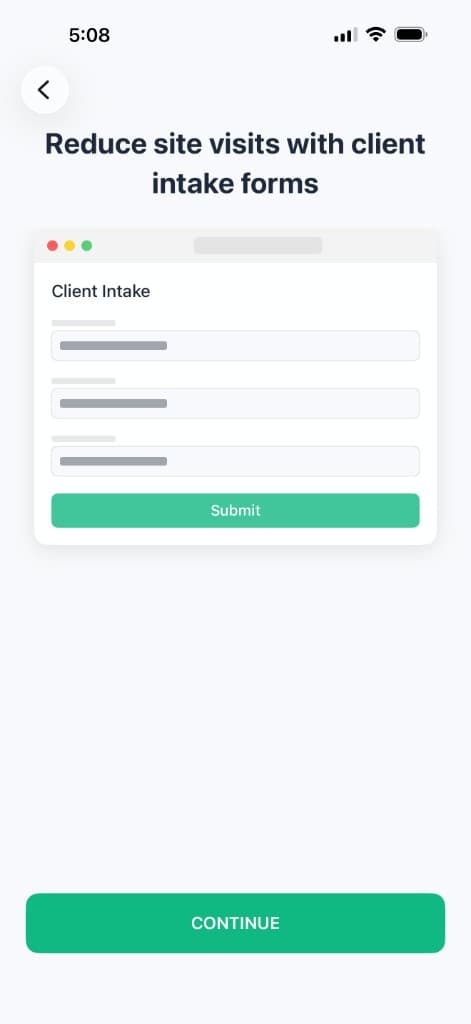
Fewer rounds of questions
Send one intake link and the client answers the AI's questions about access, condition, and scope in their own time. You stop playing phone tag and they stop feeling interrogated.
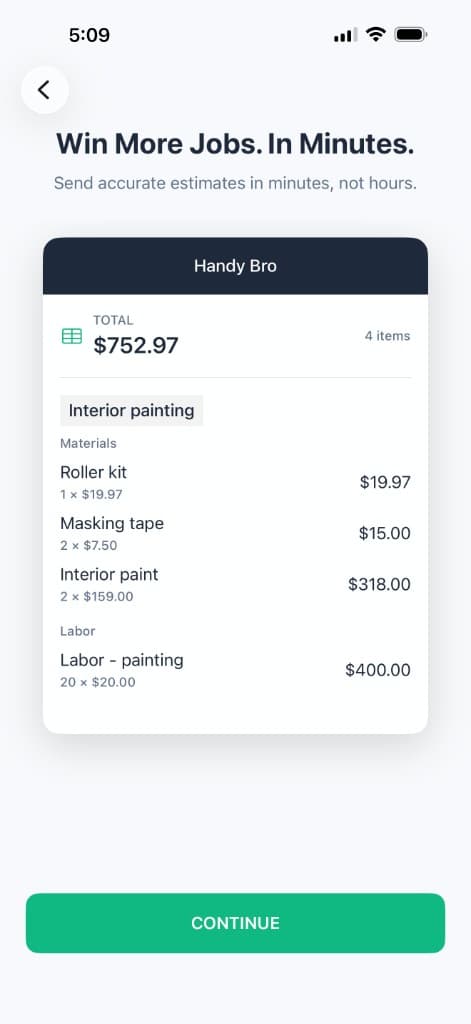
A scope they can actually read
The AI drafts the task list and plain-language description — the part most contractors skip when they are tired — and you edit every line before it goes out. Clear scope now is the argument you do not have in week three.
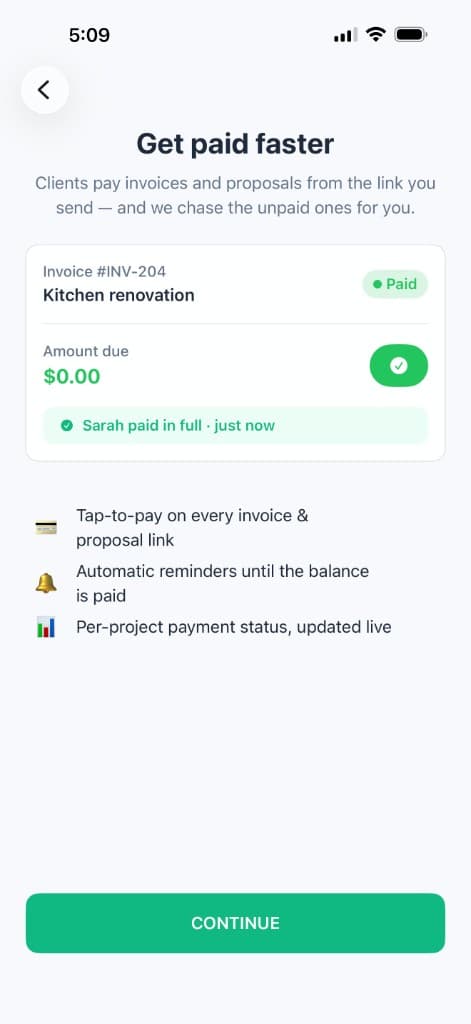
Reminders that are not you
Approved work becomes an invoice the client pays by card, and unpaid balances get chased automatically. The most relationship-damaging message in contracting is the one asking for money, and this sends it for you.
Frequently asked questions
- How should a contractor communicate with clients?
- Fast, specific, and in writing for anything that involves money or scope. Practically that means replying to inquiries within the hour, confirming what was agreed after every verbal conversation, giving a scheduled update on multi-day jobs, and never letting a client discover a problem before you tell them. The habit that matters most is proactive contact: clients almost never complain about hearing too much, and almost every serious dispute starts with a silence.
- How quickly should I reply to a client inquiry?
- Within the hour during working days, and within five minutes for anything urgent or any lead you paid for. The reply does not need a price — it needs to confirm you do this work, reference something specific they sent, ask at most two questions, and commit to a time for the quote. Homeowners typically contact several contractors in one sitting, and the one who responds first frames the entire comparison.
- What should I say when a job is going to be delayed?
- Tell them the day you know, state the fact before the explanation, and bring two or three options with the cost and time impact of each, plus your recommendation. Then send a short written summary of whatever you decide. Delays are normal in construction and most clients handle them fine; what they do not forgive is finding out late or being managed with vague reassurance.
- How do I handle a client who keeps adding small jobs?
- Say yes and price it, every time, without making it awkward: “Happy to — I will add it to the list and send you a price tonight.” Genuinely two-minute favours can be free, but say out loud that you are doing them so the generosity is visible. Scope creep is rarely malicious; it is a client who does not realize that ten small additions are a day of work. An itemized change order makes that obvious without any confrontation.
- Should I text or email clients?
- Use whichever channel the client started in for day-to-day conversation, and use writing — email or a formal document — for anything about money, scope, or approvals. Texting is fine and often preferred, but a thread of two hundred messages is not a record you can find anything in. The reliable pattern is: talk however they like, then confirm decisions in a document that both of you can pull up later.
- How do I tell a client I made a mistake?
- Directly, immediately, and with the fix already decided. “I measured the opening wrong and ordered the wrong size. The correct one arrives Thursday and I am covering the difference.” Contractors overestimate how much an admitted mistake costs them and badly underestimate how much a suspected cover-up costs. Owning an error quickly often ends up strengthening the relationship, because it tells the client what you do when nobody is watching.
- What is the best way to handle change orders?
- In writing, priced, and approved before the work happens — with no exceptions, including for clients you like. Describe what changed, why, the cost, and the schedule impact, then get an approval you can point to. Say the policy out loud at the start of the job so the first change order is not a surprise. Verbal change orders are the single most common cause of unpaid final invoices in residential work.
- How often should I update a client during a job?
- Daily on anything that lasts more than two days, even if the update is that nothing visible happened. A two-line message with a photo at the end of the day is enough. It costs a minute and it eliminates the anxious phone calls, the drop-in visits, and the sense that the project is out of their control. On short jobs, one message when you arrive and one when you finish covers it.
- How can an app help with client communication?
- By making the written part effortless. Handy Bro sends the itemized proposal, records what the client approved, turns approved work into an invoice, and chases unpaid balances with automatic reminders — so the awkward money conversations happen through documents rather than through you. Clients also get a clear scope they can read, which prevents most of the misunderstandings that turn into arguments later.
- When should I fire a client?
- When the relationship is costing you more than the job pays and nothing you change is fixing it — repeated non-payment, abuse of you or your crew, or demands to do work you consider unsafe or non-compliant. Exit cleanly: bill for completed work, photograph the state of the site, hand over what a successor needs, and keep every message polite and factual. Do it early. The cost of a bad client compounds every week you stay.
The bottom line
Communication is not a soft skill in this trade; it is the part of the job the client can actually evaluate. They will never know whether your flashing detail was right, but they will know exactly how it felt to wait three days for a call back.
Start with two changes. Reply to every inquiry within the hour, even if the reply is only to say when the real answer is coming. And send one end-of-day message with a photo on every job that lasts more than two days. Those two habits alone will do more for your reviews, your referrals, and your final invoices than anything else on this list.