
Retention & Referrals
How to Turn Finished Jobs Into Referrals and Repeat Work
A referred client rarely shops your price. Here is how to earn reviews deliberately, ask for referrals without it feeling strange, and get work out of the client list you already have.
By the HandyBro team12 min read
The short answer
Contractors get referrals and repeat work by doing three specific things after the job, not by hoping. Ask for a review at the final walkthrough and send the link the same hour. Ask for referrals in one sentence, on every job, so it becomes routine rather than a decision. And keep a real list of past clients so you can reach out first — seasonally, at the one-year mark, and any week you are working on their street.
What makes people comfortable recommending you is a job that felt organized from start to finish. Handy Bro covers the part clients see: an itemized proposal they can read, a record of what they approved, an invoice they pay by card, and automatic reminders so your last conversation is not you chasing money.
Why a referred client is worth several bought ones
Compare two jobs of identical size. The first came from a paid lead: you paid for it, you were one of four contractors quoting, you drove out, you priced it carefully, and you won it on a number the client compared against three others. The second came from a neighbor of a client you finished in the spring. They called you, they mentioned the neighbor's name, and they asked when you could start.
Same work, completely different economics. The second job cost nothing to acquire, took a fraction of the selling time, closed at a price that was not shopped, and it arrived with a client who is already inclined to trust your judgment when you say something needs doing. That last part is worth more than the marketing saving, because it is the difference between a job that goes smoothly and one where every decision gets litigated.
The catch is that referral work is not free — it is deferred. It comes from jobs you already did, which means the number of referrals you get next year is being set by how you finish jobs this month. Contractors who describe their referral flow as unpredictable are almost always describing a business where nobody ever asked.
This is the natural companion to buying and generating new leads. If you have not yet built the channels that bring in strangers, start with the organic playbook; this article is about the flywheel that runs after those clients become finished jobs.
The six moments clients actually judge
Homeowners cannot evaluate your work. They can see whether the tile is straight, but they have no idea whether the substrate was right or whether the wiring in the wall is up to code. So they judge the things they can perceive, and those are what get described when somebody asks them for a recommendation.
| Moment | What they take from it |
|---|---|
| The callback | How fast you got back to them, and whether you did what you said you would do before any money was involved. This is the client's only sample of your reliability, and they weight it heavily. |
| The arrival | On time, or a message when you are not. Clean truck, introduced yourself, took your boots off or laid a runner without being asked. It is small and it is the entire first impression of the crew. |
| The explanation | Whether they understood what you were doing and why. Clients repeat your explanation to their friends — if they cannot, they have nothing to say about you except a price. |
| The surprise | Every job has one. Whether you told them the same day, showed a photo, and gave options is the single strongest predictor of whether they recommend you. |
| The end of each day | What the site looked like at five o'clock. Swept floors and stacked material read as competence, and the mess is what a homeowner stares at all evening. |
| The last hour | Walking the finished work together, explaining care and warranty, hauling everything away, and leaving the space cleaner than a client expects. People remember the ending most vividly, and the ending is cheap to get right. |
None of those require better skills than you already have. They require deciding that the ending of a job is part of the job. The last hour on site — the walkthrough, the care instructions, the haul-away, the final sweep — generates more word of mouth than any other hour of the project, and it is the one most often rushed because the next job is already waiting.
Getting reviews on purpose
Reviews are the version of word of mouth that works while you sleep. They decide whether a stranger calls you from a map search, and they are the first thing a referred client checks before dialing, even when a friend recommended you.
- 1
Ask at the peak, not later
The best moment is the walkthrough, when the work is finished and they are visibly pleased. A week later the feeling has faded and the ask feels transactional. Say it in person first — “if you are happy with it, a short review makes a real difference to a small business like mine” — then send the link immediately while the conversation is still fresh.
- 2
Send a link, not an instruction
Nobody is going to search for your profile, sign in, and find the review box. Send the direct review link by text with one sentence. Removing the three steps between intention and action is most of the battle.
- 3
Give them something to write about
A blank review box produces “great job, highly recommend,” which helps very little. Prompting gently — “anything about the tile work or how we handled the joist we found would be great to mention” — produces reviews that describe the job, and those are the ones future clients actually read and search engines actually match.
- 4
Make it part of the routine, not a decision
Attach the ask to the final invoice so it happens on every job instead of on the jobs where you happen to remember. Consistency is what produces a steady stream of recent reviews, and recency matters more than total count.
- 5
Never buy, trade, or write them
Incentivized reviews violate the terms of every major platform and are easy to spot: bursts of five stars from accounts with no history. A removed profile or a filtered review set costs you far more than the reviews were worth. Earn them slowly.
- 6
Reply to all of them
A specific thank-you on a good review reads as a real business. Replies are also read by everyone deciding whether to call you, which makes the reply section a second chance to sound like someone worth hiring.
One quiet advantage: reviews that describe the specific job are increasingly what both search engines and AI assistants read when deciding who to recommend for a particular kind of work in a particular place. “They replaced the rotted joists under our deck in Maplewood” is a far more useful sentence than “great service.”
What to do about a bad review
You will get one eventually, and often it will feel unfair. The instinct is to explain, in detail, exactly what happened. Resist it. You are not writing to the reviewer; you are writing to every future client who reads the exchange to find out what you are like when something goes wrong.
Reply within a day or two. Keep it to three or four sentences. Acknowledge their experience without conceding facts that are not true, state plainly what you did or offered to do, and invite them to contact you directly to resolve it. No sarcasm, no listing their behaviour, no mention of what they owe you. A calm reply under an angry review is genuinely persuasive — it reads as the account of someone who has nothing to hide.
Then do the arithmetic. One critical review sitting among a steady stream of recent positive ones barely registers; one sitting among four total reviews dominates your profile. The real remedy for a bad review is volume of honest recent ones, which is another argument for making the ask routine rather than occasional.
Request removal only when a review actually breaks the platform rules — it is fake, it is from someone who was never a customer, or it contains abuse or personal information. Trying to get a genuine unhappy client silenced rarely works and reads badly when it fails.
Asking for referrals without being awkward
The awkwardness is almost entirely on your side. Clients who are pleased with a job are usually glad to help and simply never think of it, because recommending a contractor is not something that occurs to people until somebody asks them for one.
The mechanics that make it easy: ask once, keep it to a sentence, say why it matters, and be specific about what you want. “If you know anyone who needs work like this” is better than “tell your friends about us,” because it gives them a category to search their memory for.
At the final walkthrough
“I am glad you are happy with it. Most of my work comes from people passing my name along — if anyone you know needs something similar, I would really appreciate the introduction.”
When they thank you for something specific
“Thank you — that means a lot. If you know anyone else dealing with the same thing, send them my way and I will take good care of them.”
In the invoice or the completion message
“Thanks again for having us. Referrals are how this business grows, so if a neighbor asks who did the work, I would be grateful for the mention.”
To a client who has hired you twice
“You have had me back a few times now, which I appreciate. Is there anyone in your circle I should be introduced to? I would rather work with people like you than chase strangers online.”
To a trade or business partner
“If you run into drywall or carpentry work you do not want to touch, send it to me and I will keep you posted on how it goes. Same the other way — I will pass along anything electrical I come across.”
When a referral does arrive, two follow-ups matter more than anything else you could do. Thank the person who sent it, straight away and specifically. And tell them how it went, whether you won the job or not. Closing that loop is what converts one referral into a habit, and it is the step nearly everybody skips.
If you thank people with something material — a gift card, a discount on their next job — keep it modest and check your state's licensing rules on referral fees first. A thank-you given after the fact sits in a very different place, legally and ethically, than a bounty advertised in advance.
The client list you already have
Every contractor is sitting on an asset they do not use. The people who hired you in the last three years already know you, already trust you, and mostly have something else that needs doing. They are not calling because they forgot, not because they were unhappy.
Build the list first, if you do not have one. Name, address, phone, what you did, when you did it. Pull it from your invoices in an afternoon. That list is more valuable than any advertising budget you could assemble, and it is currently scattered across your text history.
Then reach out with something useful rather than something promotional. The four messages below all have the same shape: a specific reason, a specific offer, and no pressure.
Seasonal, before the weather turns
Hi Sarah — it is gutter and exterior season again. I am booking through October and remembered your back gutters were borderline when I was there last spring. Want me to take a look while I am in the neighborhood?
Warranty or maintenance check-in
Hi Mark — it has been a year since we redid the deck. The stain usually wants refreshing around the two-year mark, and it is worth a quick look at the fasteners. No charge to check it if you are around one afternoon next week.
You are working nearby
Hi Janet — I am on a job two streets over from you next week. If there is anything on your list you have been putting off, it would be an easy add while my trailer is already there.
The job they postponed
Hi Tom — we talked about the basement bathroom last spring and the timing was not right. I have space opening in November and material prices have been stable, so if it is still on your list I can re-price it for you.
The third one — you are working nearby — deserves particular attention. It has the highest response rate of anything in this article, because the convenience is real on both sides: the drive is already paid for, the trailer is already there, and a small job that would not justify a trip on its own suddenly makes sense for everyone.
A yearly touch calendar
None of this needs a CRM or a marketing plan. It needs a rhythm you can keep while running jobs.
| When | What to send |
|---|---|
| At completion | Walkthrough, care and warranty explained, invoice sent, review link sent, referral mentioned once. All of it in the same hour, as a routine rather than a decision. |
| Two weeks later | A short check-in that asks nothing: is everything still behaving as it should? This is the message that catches a small problem while it is still cheap, and it is the one clients mention when they recommend you. |
| Six months | A seasonal note tied to something real — the exterior work before winter, the inspection before summer. Useful, not promotional. |
| One year | The anniversary of the job, with an offer to look at anything related. Also the natural moment for a maintenance conversation on decks, exteriors, and anything with a finish. |
| Whenever you are on their street | One message to every past client within a few blocks of your current job. This is the single highest-response message in the whole calendar, because the drive is already paid for and you can offer a small job at a price that makes sense. |
The two-week check-in is the one to add first if you add only one. It costs a text message, it catches small problems while they are still cheap to fix, and it lands at the exact moment the client is deciding what kind of contractor you were.
The paperwork that earns the referral
People recommend contractors who felt organized. Most of what they mean by that is documents: a quote that arrived when promised, a scope they could read, an invoice that matched what was agreed. Handy Bro is built to make a one-truck operation look and behave like a company, on iPhone and Android.
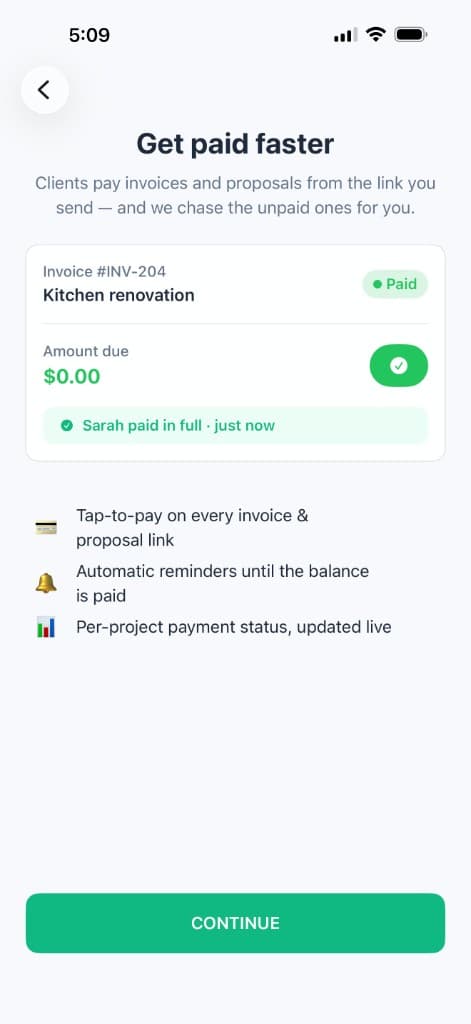
End the job on a good note
The approved proposal becomes an invoice the client pays by card, and unpaid balances get chased automatically. The last memory of the job is a clean transaction rather than three weeks of you asking for a check — which is the moment the referral is won or lost.
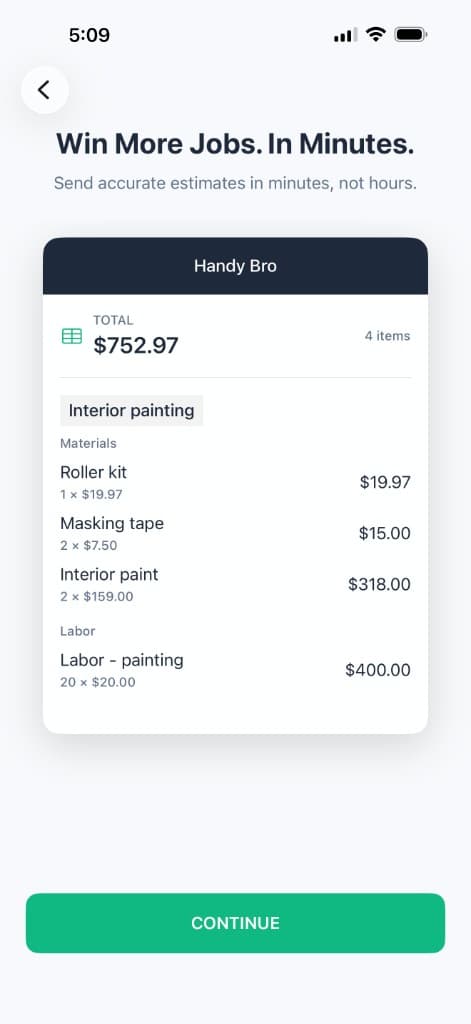
A record of every job you finished
Estimates, proposals, and invoices stay together with the client and the address, so re-pricing last year's deck or messaging everyone on a street you are working takes minutes instead of scrolling through text threads.
Frequently asked questions
- How do contractors get more referrals?
- By earning them and then asking for them, in that order. The earning part is mostly reliability and communication rather than exceptional craftsmanship, since clients cannot judge the craftsmanship. The asking part is the step almost everyone skips: a single sentence at the final walkthrough, repeated on every job, that tells the client referrals are how your business grows. Contractors who make that ask a routine get several times the referrals of contractors who wait to be recommended.
- When is the best time to ask for a review?
- At the final walkthrough, while the client is looking at finished work and feeling good about it. Ask in person, then send the direct link by text within the hour so there is no gap between the intention and the action. Asking a week later works far less often, because the emotional peak has passed and the request feels like an obligation rather than a favour.
- How do I ask for a review without being pushy?
- Be brief, be honest about why it matters, and ask once. “If you are happy with how it turned out, a short review really helps a small business like mine” is enough. Then send the link and never mention it again. The pushiness people dislike comes from repetition and from incentives, not from the request itself — most clients are genuinely glad to help and simply never think of it on their own.
- What should I do about a bad review?
- Reply calmly, publicly, and briefly, then move the conversation offline. Acknowledge their experience without arguing the facts, state plainly what you did or offered to do, and invite them to contact you directly. You are not writing for the reviewer; you are writing for the hundred future clients who will read the exchange and judge how you behave under pressure. Never post details of a dispute and never respond angrily. Only ask a platform to remove a review when it genuinely breaks the rules — fake, from a non-customer, or abusive.
- Should I pay people for referrals?
- You can, but keep it clean and check your state's rules first, since some licensing regimes restrict referral fees. A modest thank-you to past clients — a gift card, a discount on future work — is common and generally fine. What causes trouble is a fee large enough to make someone recommend you for the money rather than the work, or an arrangement that pushes a client toward work they do not need. A thank-you after the fact is safer than a bounty announced in advance.
- How do I get repeat customers as a handyman?
- Keep a real client list, and reach out first. Most repeat work does not happen because the client forgot you exist, not because they were unhappy. A short seasonal message, a maintenance check-in on work with a finish, and a note whenever you are working on their street will produce more repeat jobs than any advertising you could buy. Handyman clients in particular almost always have a second list of small tasks waiting.
- How many reviews does a contractor need?
- Enough to look established, and recent enough to look active. A steady trickle beats a large number that all arrived two years ago, because both people and ranking systems weight recency. Practically, a handful of detailed reviews describing specific jobs does more work than dozens of one-line ones. Aim for a few new reviews every month as a byproduct of finishing jobs rather than as a campaign.
- What is the fastest way to get work from past clients?
- Message every past client within a few blocks of the job you are on this week and offer to look at anything on their list while your trailer is nearby. The response rate on that message is unusually high because it is genuinely convenient for them and cheap for you. If you have no list, build one now from your invoices — name, address, job, and date is enough.
- Do referrals negotiate on price?
- Far less than strangers do. A referred client arrives with the trust problem already solved by someone they know, so the conversation starts at whether they want the work rather than whether you can be trusted with it. They also tend to compare fewer bids. This is the underrated financial argument for referral work: the same job, at a better price, with less time spent selling it.
- How does Handy Bro help with repeat work?
- The professional trail is what makes people comfortable recommending you. Handy Bro sends a branded, itemized proposal, keeps a record of what was approved, converts it to an invoice the client pays by card, and chases unpaid balances automatically so the last interaction of the job is not you asking for money. Your finished jobs and clients stay in one place instead of scattered across text threads, which is what makes reaching out again possible at all.
The bottom line
Referrals feel like luck and are actually a process. The contractors who seem to have endless word of mouth are usually just the ones who finish jobs deliberately, ask once every single time, and keep a list.
Add two things to your next completed job. Ask for the review at the walkthrough and send the link before you drive away. Then put a reminder in your phone for two weeks out to check in. Do that on every job for a season and the pipeline problem you have been trying to solve with advertising starts solving itself.