
Lead Generation
How to Get Construction Leads That Actually Turn Into Jobs
Buying leads is easy. Turning them into booked work is where the money is made or lost. Here is what each channel really costs per job, and the two habits that convert more of what you already get.
By the HandyBro team13 min read
The short answer
Contractors and handymen get leads from six channels: referrals from past clients, a Google Business Profile that ranks locally, Google Local Services Ads, shared lead marketplaces, partnerships with other trades and realtors, and job-site visibility. The free channels produce the best clients and take months to mature; the paid channels produce work this week and stop the moment you stop paying. A working business runs both.
The channel matters less than two habits: reply within minutes, and get a real price in front of the client the same day. That is what Handy Bro is for — an intake link collects the client's photos and details, the app turns them into an itemized estimate with labor and live material prices, and you send a branded proposal from your phone before the competing bids are even scheduled.
The only lead number that matters
Every platform sells you on cost per lead, because it is the smallest number they can show you. It is also close to meaningless. The number that decides whether a channel is worth using is your cost per booked job, and it depends as much on you as on the channel.
The chain is short. Leads become quotes at some rate — call it your qualification rate. Quotes become jobs at another rate — your win rate. Multiply the two and you have the fraction of leads that turn into work. Divide the lead price by that fraction and you have what each booked job actually cost you in marketing.
Run it once with your own figures. Suppose leads cost $45. You quote two-thirds of them and win one quote in four. That is one job for every six leads, so $270 of lead spend per booked job. On a $12,000 bathroom, nobody cares. On a $400 repair, you just worked for the platform. Same channel, same price, completely different verdict — which is why contractors argue endlessly about whether bought leads work.
Two things follow. First, judge every channel by average ticket, not by lead price. A channel that sends small jobs has to be far cheaper to survive the math. Second, and more usefully: notice that raising your win rate from one in four to one in three cuts that $270 to $180 without spending another dollar on marketing. Conversion is almost always the cheapest lever you own, which is the subject of our guide on winning more bids.
Every lead channel, and what each is actually good for
No channel is universally best. Each one delivers a different kind of client with a different level of price sensitivity, and the right mix depends on your trade, your ticket size, and how full your schedule is right now.
| Channel | How the lead arrives | What it costs |
|---|---|---|
| Referrals from past clientsIt only compounds if you ask. Most contractors never ask, then call referrals unpredictable. | A call or text with your name already trusted. | Free, but capped by how many jobs you have finished. |
| Google Business ProfileRanking is tied to proximity, category accuracy, and review velocity. A dormant profile ranks like a closed business. | Map-pack calls and messages from people searching your trade plus your town. | Free to run; costs photos, reviews, and consistency. |
| Local Services AdsRequires license and insurance verification, and your answer rate feeds the ranking. | Phone calls from the very top of Google, badge attached. | Per lead, with disputes available on bad ones. |
| Search adsBroad match burns money on tire-kickers and DIY searches. Negative keywords are the whole game. | Clicks to your site or a call button. | Per click, whether or not anyone calls. |
| Lead marketplacesYou are buying a race, not a customer. Worth it only if you can reply within minutes. | Shared leads pushed to you and three or four competitors at once. | Per lead, often non-refundable unless disputed. |
| Trade and adjacent partnersFragile if you drop the ball once. They are lending you their reputation. | Plumbers, electricians, realtors, designers, and property managers passing work they cannot take. | Free, or reciprocal referrals. |
| Neighborhood apps and local groupsOpenly advertising gets you removed. Being useful gets you named in the threads. | Recommendation threads and direct messages. | Free, costs time and tact. |
| Signage and job-site visibilityEntirely dependent on the crew looking organized and the site staying clean. | Neighbors who watched you work for a week and want the same thing. | Nearly free — a truck wrap, yard signs, a stack of cards. |
| Repeat and maintenance workImpossible if past jobs live in your text history instead of a list. | You reach out, not the other way around. | Free, requires a client list you actually keep. |
Read that table as a portfolio rather than a menu. Paid channels are a tap you can open when the calendar looks thin in three weeks. Free channels are an asset that takes a season to build and then keeps producing. Contractors who only run paid leads are renting their pipeline, and the rent goes up. Contractors who only wait for referrals have a great business until one slow quarter empties the schedule and there is nothing to turn on.
Making shared marketplace leads pay
Angi, Thumbtack, Networx, Porch and the rest sell the same lead to several contractors. That is the product, and complaining about it is like complaining that auctions have other bidders. What you can control is whether you are equipped to win a race you paid to enter.
The contractors who make money on these platforms behave the same way. Notifications are on and audible, including during the workday. They reply within minutes, from the truck, with a short message that names the specific job rather than a generic greeting. They have a two-minute qualifying script and are willing to fail a lead fast. They cap their monthly spend and dispute the leads that are clearly junk — wrong number, wrong trade, wrong state — because those disputes are the only refund mechanism you get.
The ones who lose money treat a bought lead like an email. It sits for six hours. By the time the callback happens, the homeowner has spoken to two people and has a number from one of them. The lead was not bad; it went stale in the inbox.
Two rules worth setting before you spend anything. Turn off every job category where the average ticket cannot absorb your cost per booked job — for most operators that means unsubscribing from the small-repair categories and keeping the ones with real scope. And give any platform ninety days with tracked numbers, then decide with the scorecard at the end of this article rather than with a feeling.
Google Local Services Ads and search ads
Local Services Ads sit above everything else on a Google search for a local trade, and they charge per lead rather than per click. To run them you go through a verification process — license, insurance, and usually a background check — and that verification is the point. The badge is doing work for you before anyone calls.
The mechanics reward availability. Google factors in your review score, your proximity to the searcher, your responsiveness, and whether you actually answer the phone. Missed calls do not just lose that job; they lower how often you get shown. If you cannot answer during the day, set the ads to run only when someone can, or route to an answering service that books appointments rather than taking messages.
Ordinary search ads are a different animal. You pay per click whether or not the click ever becomes a conversation, so intent control is everything. Bid on the searches that describe your work plus your area, and build a long negative-keyword list to keep out the people looking for DIY instructions, salaries, free estimates for insurance paperwork, and your own trade's job listings. Send the click to a page about that exact service, not to a homepage. And check your call recordings occasionally — nothing reveals wasted spend faster than hearing what people are actually calling about.
One practical note for small operators: paid search rewards being able to spend consistently for a couple of months while the account learns. If you can only fund it in bursts, put the money into Local Services Ads or into the free channels instead.
Qualifying a lead in two minutes
A bad lead costs far more than the fee. It costs the drive, the hour on site, the evening spent pricing, and the two weeks of hoping. Qualification is not rudeness; it is the thing that lets you give real attention to the leads that deserve it.
Four questions do most of the work. What exactly needs doing, and can you send photos? Where is the property? When are you hoping to start? And have you had other quotes, or is this the first? That last one is worth asking because the answer tells you what game you are in — first mover, or the third bid used to negotiate someone else down.
Then be willing to walk. These are the signals that a lead should not get a site visit:
- The address is outside the radius you can service profitably, once drive time is counted twice a day.
- The scope needs a license or a trade you do not hold, and subbing it out would make you the low-margin middleman.
- The budget the client names is less than half of what the work costs, and they present it as a firm number.
- They are collecting bids for an insurance claim or a permit application that has not been approved.
- They will not send photos, will not answer questions, and want a firm price over the phone.
- The timeline is impossible — they want to start Monday on a job that needs a two-week material lead time.
Say no cleanly when you see them. “That is outside the area I cover, but here is someone I trust who works over there” costs you nothing and occasionally comes back as a referral. Ghosting a lead you do not want is the only version of this that hurts you.
The efficient version is to let the client do the qualifying themselves. Send one intake link that asks for the address, the photos, the scope, and the timeline. People who are serious fill it in within the hour. People who will not answer three questions were never going to sign a contract, and you learned that from a roof instead of from their driveway.
Speed to first response beats every marketing budget
If you change one thing after reading this, change how fast you reply. Homeowners contact several contractors in one sitting and start forming a preference immediately, usually for whoever treats the message like it matters.
| Time to first reply | What is happening on the client's end |
|---|---|
| Within 5 minutes | You are almost certainly the first human they have spoken to. On a shared marketplace lead this is the difference between winning and paying for nothing. |
| Within 1 hour | Still strong. The client is likely to have contacted two or three others, but nobody has priced it yet. |
| Same day | Acceptable for planned remodels, weak for anything urgent. Somebody with a leak is not waiting. |
| Next day | You are now the backup quote, used to check whether the first number was fair. |
| Two days or more | For small and urgent work, the job is gone. Reply anyway, briefly and honestly — some of those leads come back when the first contractor no-shows. |
The first reply does not have to contain a price. It has to contain a person. Confirm you do this kind of work, mention one specific detail from what they sent so they know you read it, ask the one or two questions that actually change the number, and commit to a time for the quote. Then beat that time.
The second half of speed is the quote itself. Fast replies followed by a quote that takes five days is just a faster way to lose. Most of the delay is not laziness — it is that pricing a job properly used to require an evening at the kitchen table. That is the part that has genuinely changed.
Where Handy Bro fits in your lead flow
Handy Bro does not sell you leads. It is what you use on the leads you already have, so fewer of them go cold while you are on a ladder. It runs on iPhone and Android in the US and Canada.
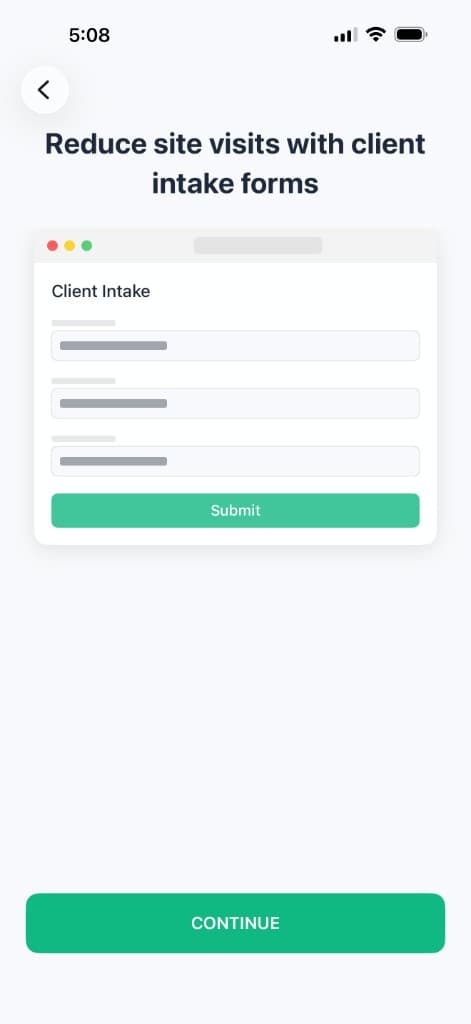
Let the lead qualify itself
Reply to a new inquiry with one intake link. The client uploads photos, describes the work, and answers AI-generated questions about access and condition — so you know whether the job is worth a drive before you commit an afternoon.
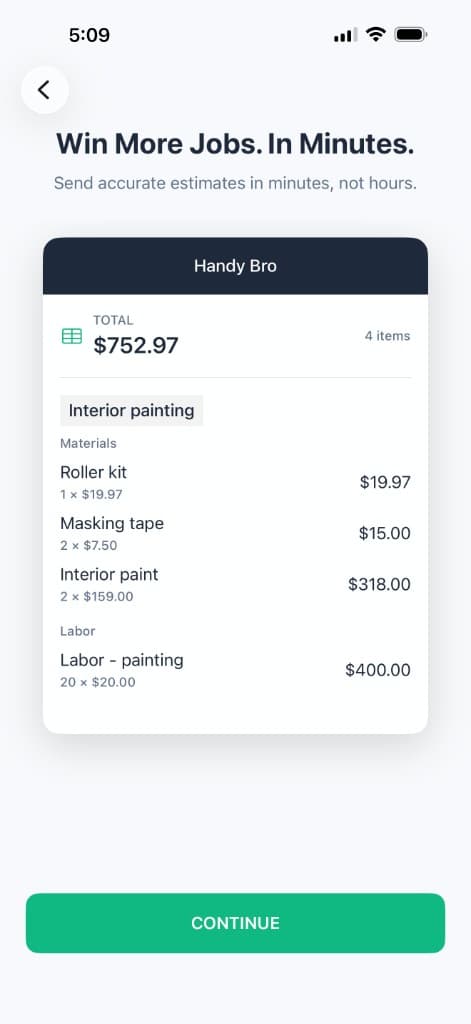
Quote the same day, from the truck
Describe the job by typing or voice, attach the photos, and get a task-by-task breakdown with labor at your rates and materials priced from live Home Depot and Lowe's data. Every line stays editable before it goes out as a branded proposal the client approves on their phone.
The reason this belongs in a lead-generation article is arithmetic. Every lead you cannot get back to is the full price of that lead, wasted. Cutting the time between inquiry and priced proposal from four days to four hours raises the win rate on leads you have already paid for, and it does that on every channel at once.
The one-page lead scorecard
Most contractors know which channel they like. Very few know which one pays. The gap between those two is usually a few thousand dollars a year, and it closes with a spreadsheet that has six columns:
- Where the lead came from
- Date it arrived and the minute you replied
- Whether you quoted it, and the quote amount
- Won, lost, or no decision
- What you spent to get it
- One line on why you lost it, in the client's words if you have them
Fill it in for ninety days. Then compute three things per channel: cost per booked job, average ticket, and win rate. You will usually find one channel quietly carrying the business, one that looks busy and produces nothing, and one that would work if you replied faster. Cut the second, fix the third, and put the money you free up into the first.
Ask every client one question when they hire you: how did you find me? Write the answer down verbatim. Attribution guesses are usually wrong, and “my neighbor had you do their deck” is a different business decision than “you were at the top of Google.”
Frequently asked questions
- How do contractors get leads?
- Through some mix of six channels: referrals from past clients, a Google Business Profile that ranks in the local map pack, paid Google Local Services Ads, shared lead marketplaces, partnerships with trades and realtors who pass along work, and visibility from signage and job sites. Most established contractors get the majority of their work from the free channels and use paid leads to fill gaps in the schedule. The mistake is depending entirely on paid leads, because the pipeline stops the day the card gets declined.
- Are Angi, Thumbtack, and HomeAdvisor leads worth it?
- They are worth it only if you can answer within minutes and you track cost per booked job rather than cost per lead. These are shared leads, sold to several contractors at once, so you are paying to enter a race. Contractors who win on those platforms have notifications on, a short qualifying script ready, and a way to send a real quote the same day. Contractors who lose money on them treat the lead like an email to answer tonight. Set a monthly cap, dispute the junk, and cancel any category where your cost per booked job exceeds your gross profit on that job type.
- What is a good cost per lead for a contractor?
- Cost per lead is the wrong number to optimize. What matters is cost per booked job, which is your cost per lead divided by your booking rate. A $40 lead you win one time in four costs $160 per job — cheap for a $9,000 remodel and terrible for a $250 service call. Work out the maximum you can pay per booked job at your average ticket and margin, then judge every channel against that figure. This is also why improving your win rate is usually cheaper than buying more leads.
- How can I get construction leads for free?
- The three highest-yield free channels are a fully built Google Business Profile with recent photos and steady reviews, deliberate referral requests from every client you finish, and relationships with trades and realtors who regularly encounter work they cannot do. Add job-site signage and being genuinely helpful in local groups. Free channels take three to six months to produce a steady flow, which is exactly why most contractors quit them right before they start working. There is a full playbook in our guide to free leads for contractors.
- How fast should I respond to a new lead?
- Within five minutes for anything urgent or bought, within the hour for everything else. Speed matters more than polish: a homeowner who texted three contractors this morning has usually chosen one by that evening. You do not need a finished quote in five minutes — you need a real human reply that confirms you do this work, asks two specific questions, and states when the price is coming. Then hit that time. The quote that arrives when you said it would does most of the selling.
- How do I stop wasting time on bad leads?
- Disqualify early and in writing. Publish your service radius, state your job minimum before you drive out, and ask for photos in the first reply. If the client will not send photos or answer basic questions, that is information. A short intake form does most of this for you — it collects the address, the photos, the scope, and the timeline while you are on a roof, and lets you decide whether the job is worth a visit before you spend the fuel.
- Do I need a website to get leads?
- You need a place that proves you are real, and a Google Business Profile plus a simple site is the cheapest version of that. Even when leads come from a marketplace or a referral, people look you up before calling. Photos of finished work, the areas you serve, your license and insurance status, and a way to contact you are enough. A one-page site that loads fast beats an elaborate one that nobody finishes building.
- How many leads do I need to stay booked?
- Work backwards. If you need eight jobs a month and you win one bid in three, you need twenty-four quotes, and if half of your leads are qualified enough to quote, you need roughly fifty leads. Run that math with your own numbers once and the marketing question turns concrete: either find more leads, or raise the two conversion rates. Raising the rates is almost always cheaper, which is why quoting fast and following up beats buying more volume.
- Can an app help me convert more of the leads I already have?
- Yes, and that is usually where the cheapest wins are. Handy Bro sends clients an intake link that collects photos and job details for you, then turns the description into an itemized estimate with labor and materials priced from live Home Depot and Lowe's data. You review and send it as a branded proposal the client can approve on their phone. The point is that the quote goes out the same day, while the lead is still deciding, instead of piling up for the weekend.
- Should I buy leads or invest in marketing?
- Do both, in a specific order. Buy leads when you need work this month, because paid channels turn on immediately. Build the free channels at the same time, because they take a season to mature and then keep producing without a monthly bill. A practical split is to fund paid leads out of the jobs they produce, and spend two hours a week on the profile, the reviews, and the partner relationships that eventually replace them.
The bottom line
Lead generation gets treated as a spending problem when it is usually a response problem. Before you add a channel, look at the leads that came in over the last month and count how many never got a real reply, how many got a reply but no price, and how many got a price after the client had already decided. That count is your cheapest source of work.
Then build the mix deliberately: paid channels for this month's schedule, free channels for next year's, and a scorecard that tells you which is which. The contractor who wins is rarely the one with the biggest marketing budget. It is the one whose quote arrived first and looked like it came from a real business.